

I had a quiet moment of reflection after watching Bendigo Bank’s new commercial featuring Wakool farmer and butcher extraordinaire Hayley Patterson. The ad campaign titled Bigger for You points the finger at the ‘big four’, citing the Bendigo Bank is “Bigger for the community I care about”. It’s a great line, it’s good advertising, but I feel our community is still poorer for not having our banking agencies following the bank’s decision to close the Barham and Cohuna Bendigo agencies.

The Bendigo Bank isn’t alone in the desire to close branches and boost their dazzling profits. Around one third of regional bank branch services, almost 800 in total, have closed in the 6 years to June 2023 with half of the ATMs in regional Australia following suit. Last financial year, Australia’s big banks saw profits soar to $32.5 billion, up $4 billion (or 14 per cent) from the previous year.
The banks maintain that they are merely following the consumer trend with more online transactions, and fewer face-to-face. It’s unknown what percentage of the change is driven by the inability to access face-to-face services with closures and reduced hours at many branches.
What is the cost of a fully digital economy? The parasitic charges on digital transactions soon add up. As a small business owner, someone can pay me with a $50 note, and that note’s value remains fixed at $50. Conversely, if I opt for an online payment plug-in for my accounting software, 1.8 per cent of all my bills could be swallowed up by this ‘service provider’.
My EFTPOS machine is no different. Every transaction carries this parasitic charge, shrinking revenue and boosting bank profits. Imagine a world where you couldn’t give your hard-earned, already taxed, money to your grandkids or the footy club raffle without giving a percentage to a bank parasitic fee.
Cash is freedom. The last three years have proven that on multiple occasions, sitting on the wrong side of a political debate or protesting government policies can and will result in de-banking.
Help may be at hand, with the federal government last week releasing the final report on bank closures in regional Australia.
The report concluded with eight recommendations, the first three being:
Recommendation one sought that the Australian Government adopt a policy recognising access to financial services as an essential service. To this end, it should commit to guaranteeing reasonable access to cash and financial services for all Australians.
Recommendation two called for the Australian Government to commission an expert panel to investigate the feasibility of establishing a publicly owned bank. In investigating this, the panel should examine options, including but not limited to a stand-alone public bank or one associated with, and using the branch network of Australia Post.
And recommendation three, the committee recommends that the Australian Government urgently develop a mandatory Banking Code of Conduct or Customer Service Code (Code), incorporating a robust branch closure process, to be administered by a regulator with expertise in consumer protection.
Over 600 written submissions and more than 13 hearings aided the committee’s conclusion.
Federal Member for Mallee Dr Anne Webster said this week, “Regional Australians must never forget that during the Global Financial Crisis, the Reserve Bank issued $73 billion in bonds through a guarantee scheme which, at its peak, covered $170 billion of bank liabilities. The RBA later determined those guarantees were worth an implicit $1.88 to $3.75 billion to the major banks, or $2.32 to $4.62 billion in today’s terms. Banks have a moral obligation to support all taxpayers for that assistance and should stop cutting services in regional Australia.”
In providing expert testimony to the hearings, witness Andy Schmulow, Associate Professor of Law from the University of Wollongong said, “When it comes to closing branches, Australia is a free for all in which banks are entirely unconstrained: there is no degree to which they are held to account in discharging their obligations to communities which have supported them for generations. This, it is respectfully submitted, is disgraceful and indefensible,” Dr Schmulow said.
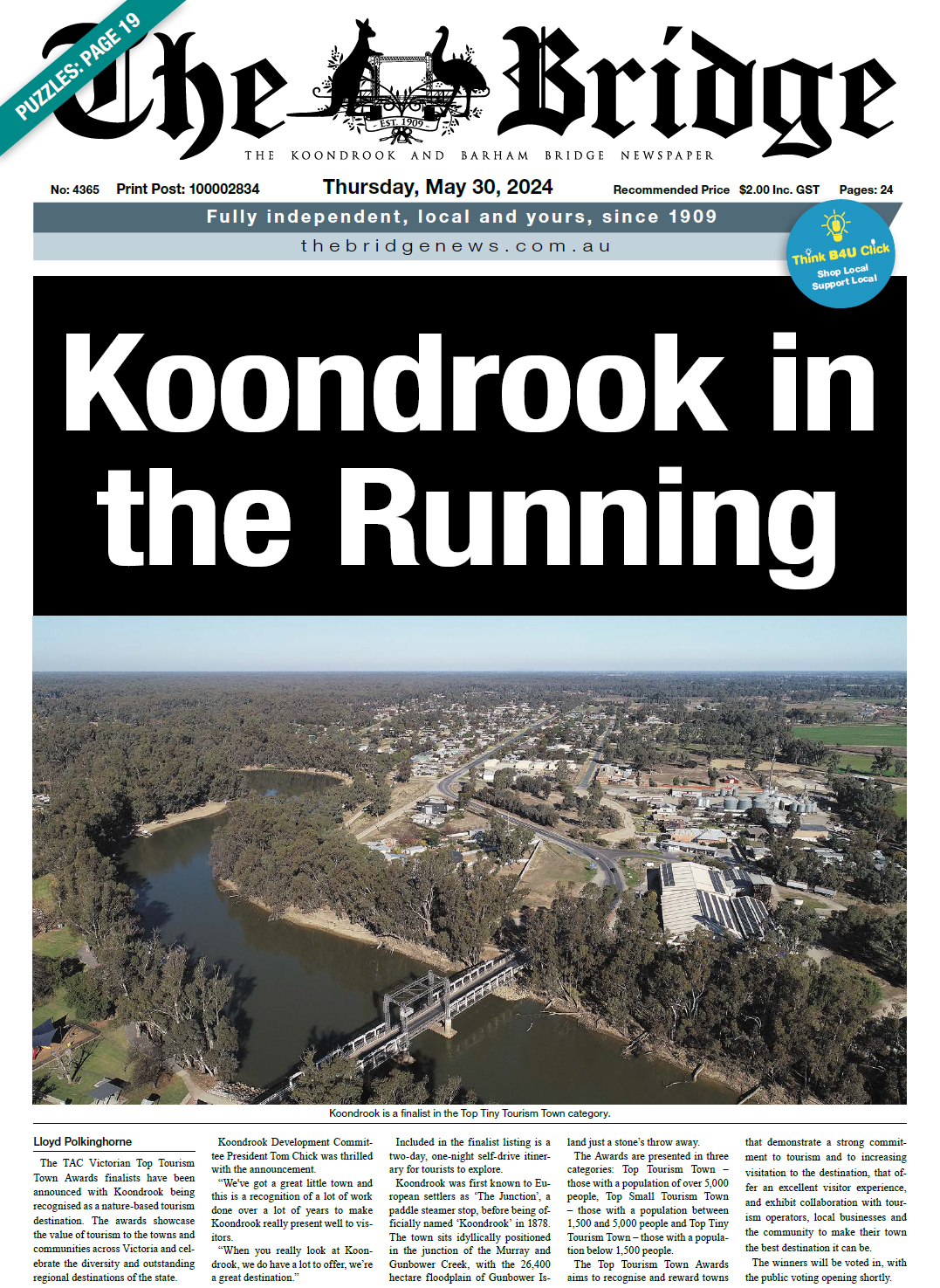
This article appeared in The Koondrook and Barham Bridge Newspaper, 30 May 2024.
