

At least 749 properties will receive a decrease in council rates under a proposal by Naracoorte Lucindale Council’s administration.
The decrease is included in a breakdown of the average 5.8 per cent rate hike included in council’s draft 2024-25 Business Plan and Budget.
There are 6578 rateable properties in the council area, and Cr Monique Crossling claimed during council’s May 1 meeting an average 5.8 per cent increase was an extra $17.73 over a year.
Those with no rate rises or increases of up to 5.8 per cent include 2,869 assessments, or 43 per cent of the 6578 properties.
Owners of 2616 properties will have their rate bills hit with increases of more than 5.8 per cent.
Rate hikes of 20 per cent or more face 69 properties, mainly residents of Naracoorte, Lucindale and Frances.
Further rate hikes of 10 – 20 per cent target 669 farming families.
Almost 1878 rate bills will increase by 5.8 to 10 per cent.
According to the Australian Bureau of Statistics, Annual Consumer Price Index (CPI) was 3.6 per cent in the March quarter, lower than the 4.1 per cent in the previous quarter.
No ratepayers or electors attended the May 1, special meeting when council’s management team unveiled its draft business plan and budget.
As previously reported by The [Naracoorte Community] News, there was a mixed reaction to the proposed average 5.8 per cent rate hike.
The administration’s 5.8 per cent rise was part of a 10 year plan proposed by council’s management team which included a 5.8 per cent rise in rates again next financial year.
But as the next Local Government election loomed, that rate rise would drop to 3 per cent – regardless of CPI.
Cr Darren Turner explained he had a more equitable and palatable proposal with a rate increase of 4.8 per cent this year, and again next year, followed by a 4 per cent increase in 2026.
CEO Trevor Smart praised the discussion between members stating there were some “good ideas and good suggestions”.
Mr Smart explained if the rate rise was 4.8 per cent, the $1 million surplus would be reduced by $100,000.
He said the council needed to keep an eye on not only the cash position, but also the operating expenses.
“Because that’s where your depreciation is coming from, and that’s where cash is accumulating for new projects, etcetera,” Mr Smart said.
He advised councillors to go with the average 5.8 per cent increase.
Supporting Mr Smart, Cr Monique Crossling said: “I did do a few figures on the 5.8 per cent increase over our 6578 properties.
“On an average it would be $17.73 extra over a year, obviously not on everyone’s, but an average,” she said.
Mayor Patrick Ross said: “I remember when I was doing economics there were lies, damn lies and statistics.”
Regarding Cr Crosslings figures, outside the meeting, Mr Smart explained that as with all rates – due to some assessments having higher or lower increases – “the $17 is an average only”.
“The suggested $17 is also the difference between a 4.8 per cent and 5.8 per cent rate increase – not the total increase,” Mr Smart said.
In previous years Cr Cameron Grundy highlighted that it was rural ratepayers who would receive the highest increase in rates by up to 10 – 20 per cent, or more.
“This will change from year to year, and will be largely determined by the extent of valuation increases across the council area – and the extent of peaks and troughs of valuation increases,” Mr Smart said.
“Subsequent adjustments to the rate/$ across the differential rating zones provide opportunity for us to attempt to even out the distribution rates, as much as possible.
“An early indication of 2024/25 rate modelling – as provided for within the draft budget – effect is shown.”
Mr Smart said it was the challenge of the council to get as many rateable assessments within the three bands showing a decrease in rates, and an increase of 0 to 10 per cent.
“Those assessments greater than 10 per cent to 20 per cent are majority primary production assessments,” he said.
Mr Smart said the 69 assessments with rate increases greater than 20 per cent mainly included people with property in the townships of Naracoorte, Lucindale and Frances.
People can get copies of the draft budget and business plan from the council or its website.
They are urged to comment before 5pm, May 27 by contacting their councillor, writing a letter or emailing council or councillors, or via the council’s website.
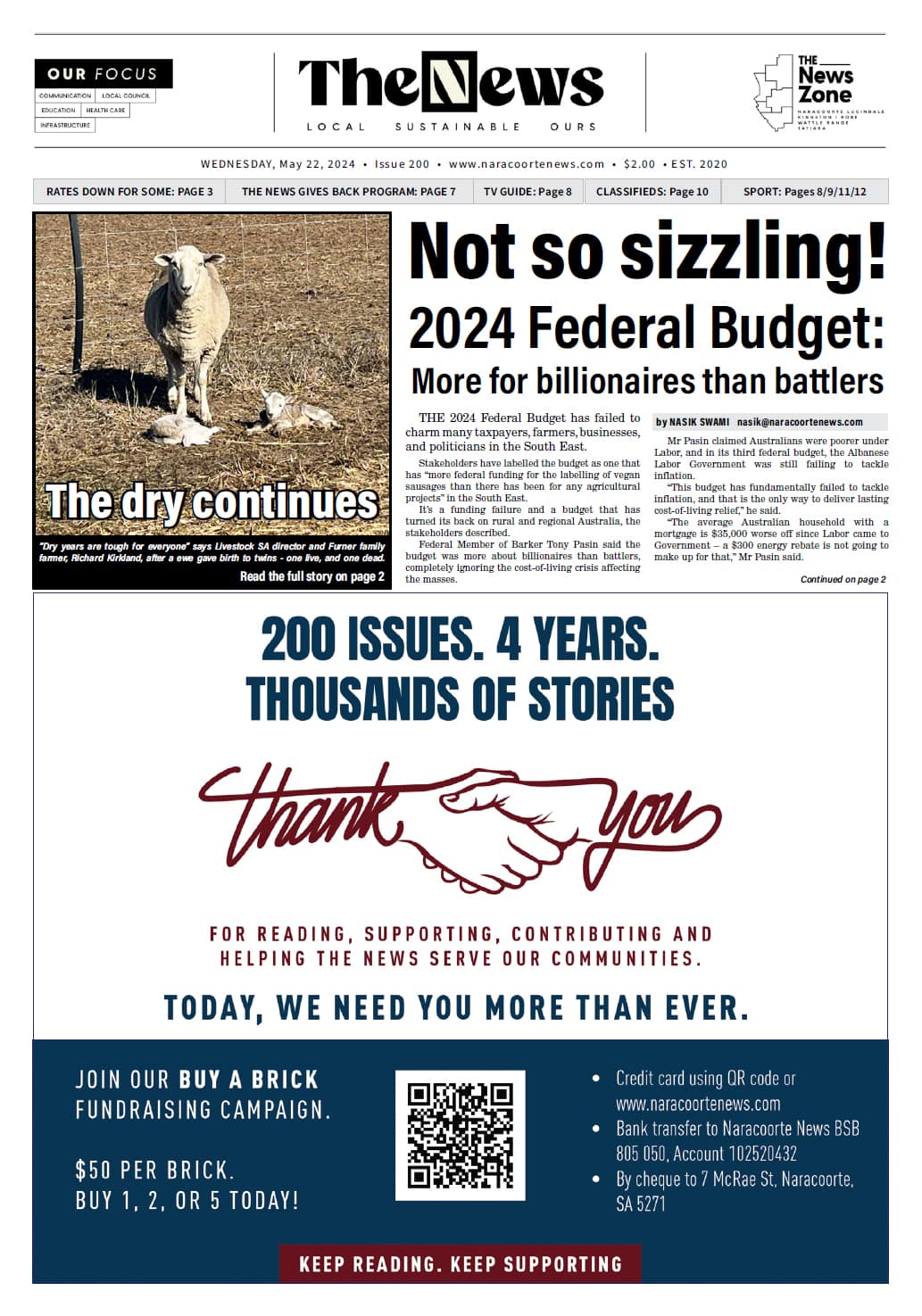
This article appeared in the Naracoorte Community News.
