


Part 1 of a three part series of articles from the conference
Philip Hopkins
Sharing information globally about the causes and impacts of destructive bushfires in an era threatened by global warming drew about 360 people to an international conference in Melbourne in June.
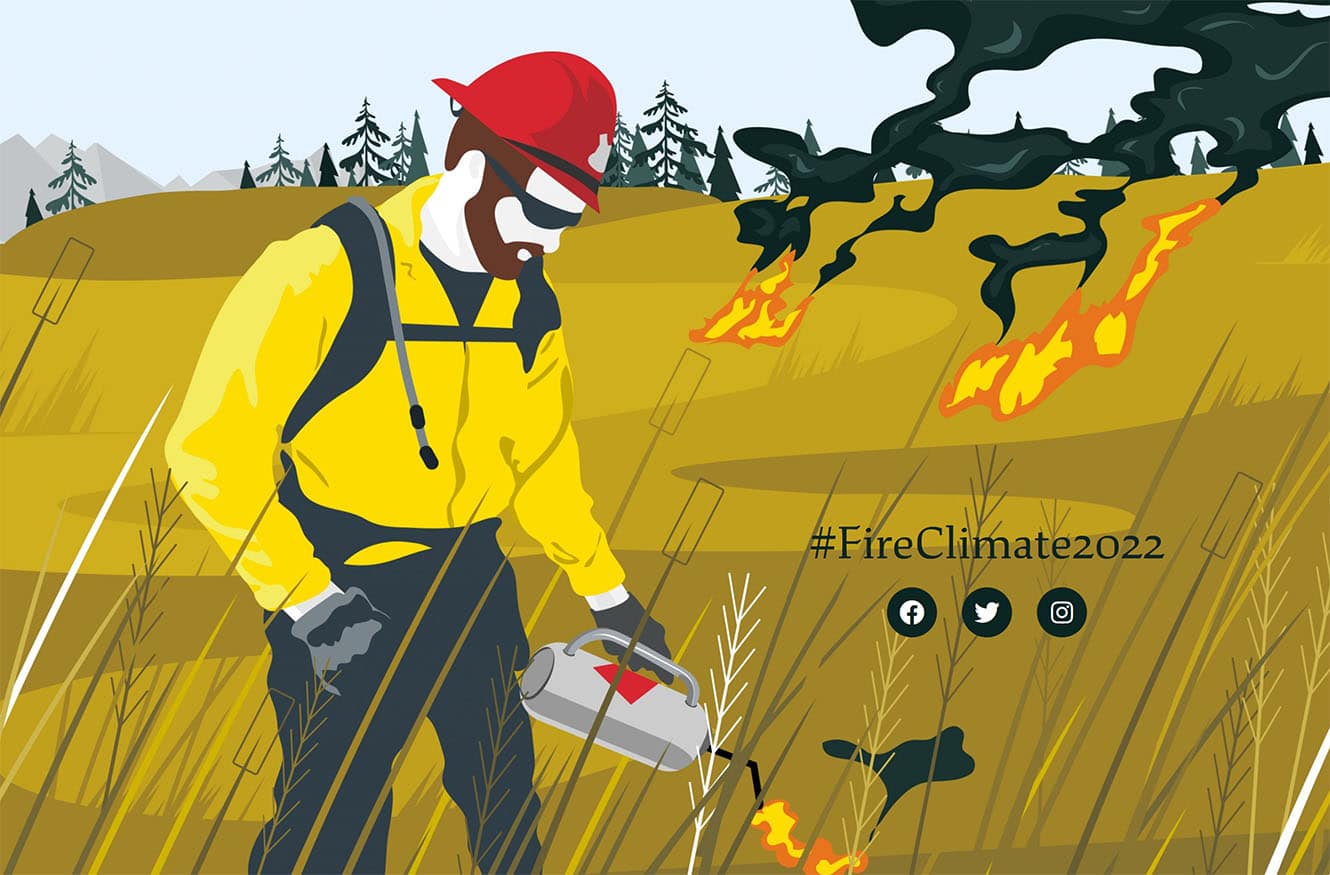
Fire & Climate 2022, presented by the International Association of Wildland Fire in partnership with Natural Hazards Research Australia, concentrated on the most significant forces shaping wildland fire today. NHRA is the successor body of two Cooperative Research Centres – the Bushfire CRC and the Bushfire and Natural Hazards CRC.
The co-chair of the conference, David Bruce, said the meeting combined science and experience to advocate better ways of managing wildland fire under climate change.
Two weeks apart, the same conference but with separate programs, was held in Pasadena, California, and in Melbourne. In Melbourne, the five-day program featured nine keynote presenters who spoke on the science, policy, planning and operations of fire and climate. Panels discussed cultural burning in Australia and North America, while there were almost 100 research and practice presentations.
Mr Bruce, a former IAWF director and NHRA communications director, said the conference subthemes, ‘Impacts, Issues and Futures’, acknowledged the need to share information globally about bushfire causes and impacts and how to minimise those impacts.
The conference began with Dr Sophie Lewis, the ACT Commissioner for Sustainability and the Environment and a lead author on the Intergovernmental Panel on Climate Change’s 6th Assessment Report.
Dr Lewis looked at what exactly a 1 degree rise in temperature means for Australia, using the 2019–20 Black Summer fires as a baseline. Even under our most ambitious attempts to limit warming by 1-2 degrees, Dr Lewis said we needed to plan for a future with conditions that would make more Black Summer type events likely. “And it is not just about the temperature extremes, the impacts will come from compound events,” she said.
“Black Summer wasn’t just one extreme event,” Dr Lewis said. “We had heatwaves, extreme smoke and then extreme rainfall falling on burnt areas while other areas were experiencing fires. We don’t really understand what this kind of future will look like. What are the new challenges of compound events? How does it stress people, infrastructure and the environment?”
Dr Amber Soja, Research Fellow at the National Institute of Aerospace in the United States and an IAWF Board member, introduced a global view of where fires are burning and the impacts on both air and land.
Dr Soja noted that most of the planet’s carbon was stored in the boreal and arctic ecosystems. “This is where climate is warming the most right now and is predicted to in future – and that’s where wildland fire has suddenly become a real problem,” she said.
“The earliest and largest fire season in the Arctic was in 2020. This ecosystem influences the entire global climate. This area is huge. The fires keep burning in the same place. So, we know it’s accessing permafrost and releasing millennia of stored carbon.”
Amy Christianson, a Métis woman from Treaty 8 territory in Canada, Indigenous Fire Research Scientist with the Canadian Forest Service and an IAWF board member, showed the parallels with Australia: fire prevention policies of past decades have reduced the use of Indigenous fire to the detriment of the landscape and the people on it, but in parts, this was starting to change for the better.
A/Prof Michael-Shawn Fletcher from the University of Melbourne followed with a geographer’s explanation on how neglect of Country was linked to the more recent rise of large fires in Australia.
Using long-term fire history in Australia as a reference, A/Prof Fletcher said there was really no such thing as wilderness – “our land has long been shaped and curated by people for their benefit and purpose”.
Oliver Costello from Firesticks outlined the research work currently underway to learn better from Country and how this should be continued by supporting those with traditional knowledge and encouraging new researchers into the field.
In the final session, leaders in a cross-section of fire-based organisations discussed the lessons of the conference and how their agencies would get ready for future challenges under climate change.
Ruth Ryan, Corporate Fire Manager at HVP Plantations, spoke about both the human and natural compounding consequences for resources.
“There’s another aspect we need to look at – people are getting worn out going from fire to flood to fire,” Ms Ryan said. “I think we need a rethink and I think it comes back to good land management. It’s got to be about building greater resilience in the land as well as our people.”
The panel members agreed that improvements in fire suppression were needed, but the biggest benefits would be realised by increasing mitigation and prevention. “They also agreed that the workforce is the most important component and more needs to be done to attract and retain people as well as prepare them psychologically for what they will experience in their jobs,” Mr Bruce said.
Related stories: Fire & Climate 2022 – Greg Mullins, Fire & Climate 2022 – Kevin Tolhurst.

