


The new practice of Seedbed Conditioning not only improves the physical, biological and chemical properties of the root zone of cropping soils, it also produces very large and near-permanent improvements in the drought AND waterlogging resilience of cropping soils.
The need for soils to absorb, store and drain water is increasingly important because climate change is causing wide variations in the frequency, duration and severity of dry and wet seasons.
Recently farmers have turned to using deep ripping, spading, clay spreading and soil inversion to improve the amount of stored soil water and the ability of crops to extract it in efforts to increase yields and resilience of their farming systems. All these practices are time consuming and expensive, and the resultant crop yields first increase and then decline over a number of seasons.
All soils re-consolidate over time, through the influence of gravity, the weight of water and the reduction in friction between wet soil particles.
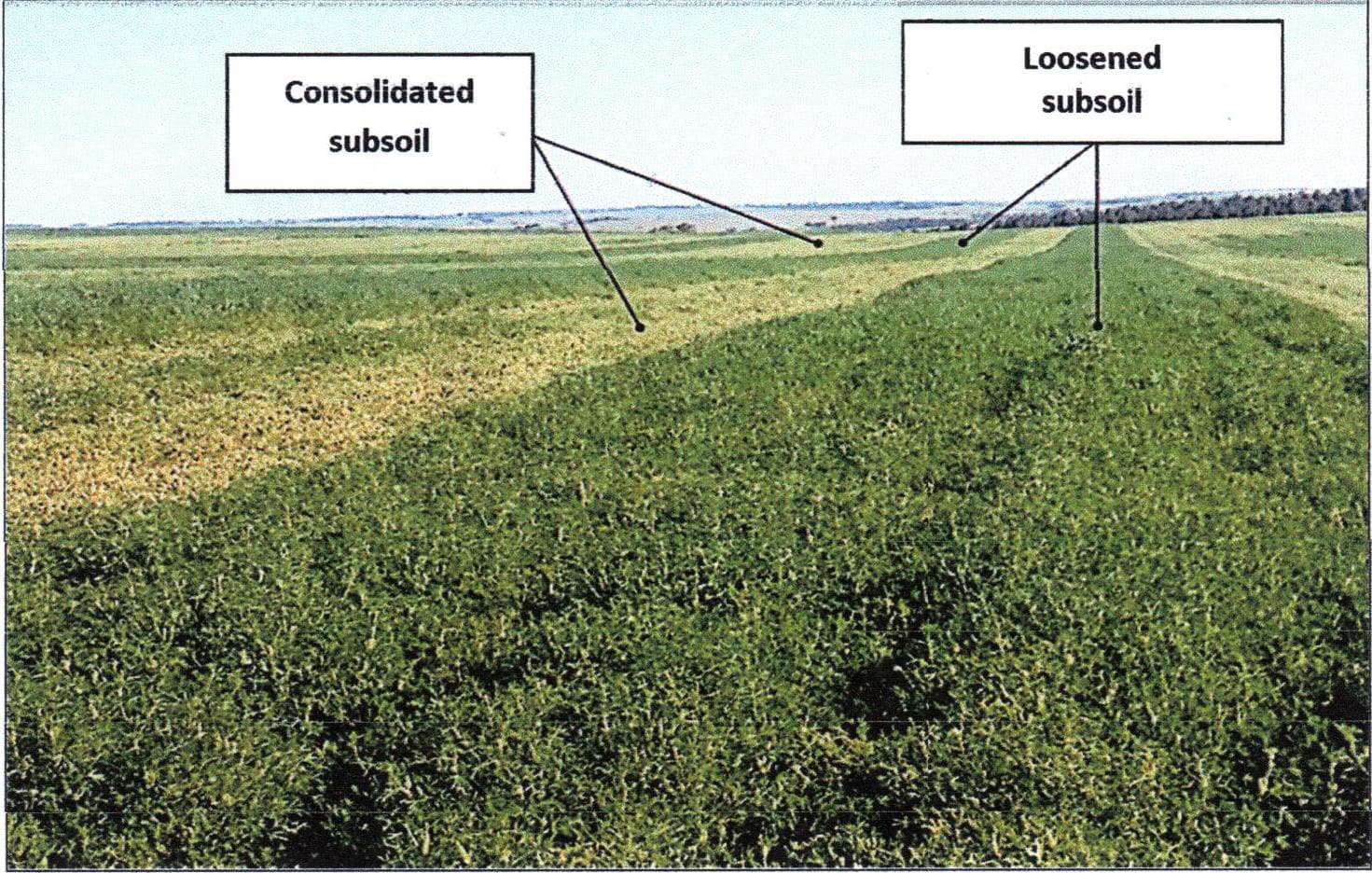
Green, taller strips, seedbeds loosened to about 300 mm depth.
To sustain higher yields and to minimise the costs, farmers have to ponder: what depth to rip, spade etc?; and, when to repeat these expensive practices?
Seedbed Conditioner machines slice through soil and crop roots at about 300 mm depth, lifting, opening and dropping un-inverted soil and undisturbed crop root systems. This action preserves enlarged root systems and aerates 300 mm depth of soil, and the undisturbed root systems reinforce the loosened soil against re-consolidation.
Worldwide research has shown that 80 per cent of all crop and pasture roots are found in the 0-300 mm depth of soil, and this is the operating depth recommended for Seedbed Conditioner machines.
The loose, root-reinforced seedbeds created by Seedbed Conditioners increase the amount and rate of water absorption, the rate of drainage and aeration, and the ease with which plant roots can absorb water. These seedbeds also reduce evaporation losses. Their surfaces dry quickly, which creates a mulch that reduces evaporation losses.
Deepened Seedbed field-scale research has been undertaken on wide range of soil types, including Gravelly sand, Sand-over-clay, Fine sandy clay loam, Fine silty clay loam, Grey clay, Fine sandy loam over clay, Deep sand, and Black self-mulching clay.
Research has shown that soils treated with Seedbed Conditioners are 300 per cent more drought and water log resilient than No-till. They hold that much more water before they become saturated, and they drain and aerate quickly. Also, they hold much more water that is easily available for plants.
Broad-scale publication and promotion of the deepened seedbed findings and the Seedbed Conditioner machines has had to await the synthesis, analysis and publication in high quality international scientific journals of large amounts of data from six research projects, approval of Australian and international patents for the Seedbed Conditioners, the design and launch of a website and the drafting of engineering construction plans for the Seedbed Conditioners.
The Seedbed Conditioner (both forms) has Australian and International patents. It is featured in the ARR.News Store.
Sales enquiries: Greg Hamilton 0481 764 070 gjhamiltong@gmail.com
The Seedbed Conditioner series of articles:
- New machine improves soil fertility and increases crop yields;
- New machine set to revolutionise Australian cropping;
- Drought and waterlogging resilience of Seedbed Conditioning;
- Increases in soil carbon and soil Carbon Credits income;
- Large increases in root growth and soil biology populations;
- Increases in soil nitrogen and reduced need for nitrogenous fertilisers;
- Sustainability/soil health of Seedbed Conditioning – increased fertility and prevention of soil-borne diseases;
- Substantial reductions in irrigation water use and application times.
Related peer-reviewed articles
- Blade loosening creates a deeper and near-stable rooting zone that raises the productivity of a structurally unstable texture contrast soil”, Soil Research, 2016, Vol 55: pp 101-113.
- “Deep blade loosening increases root growth, organic carbon, aeration, drainage, lateral infiltration and productivity”, 2019, Geoderma, Vol 245; pp 72-92.
- “Deep blade loosening and two-dimensional infiltration theory make furrow irrigation predictable, simpler and more efficient”, Agricultural Water Management, 2020, Vol 239: pp. 1-14.
Greg Hamilton is the senior author of all these papers.
Footnote: The term ‘Deep Blade Loosening’ was changed to ‘Deepened Seedbeds’ to avoid the comparison/interpretation that this practice was simply a variation of Blade Ploughing, which Australian experience showed severely inverted and churned soil, and had deleterious effects on soil fertility and productivity.
Australian Rural & Regional News is pleased to publish this series of articles sponsored by Greg Hamilton, the inventor of the Seedbed Conditioner and founder of Maximum Soil & Water Productivity Pty Ltd.

