

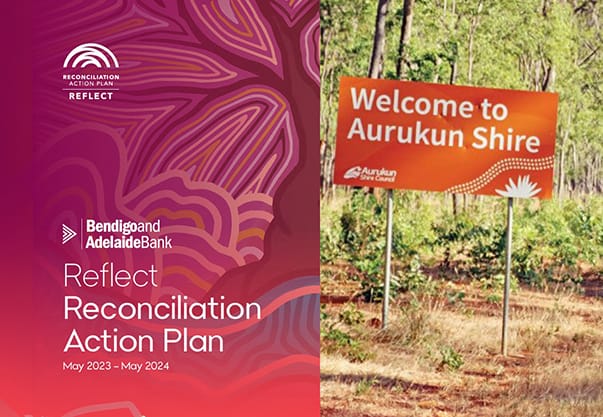
Bendigo Bank closed its last remaining banking service in an Aboriginal community 27 days before celebrating the launch of its Aboriginal Reconciliation Action Plan.
The Aurukun agency in far north Queensland was one of 27 to be closed in 2022-2023 under the eye of the bank’s now chief executive Richard Fennell when he was in charge of the consumer banking division.
It’s last official day of trade was on March 31, 2023, with the Reconciliation Action Plan (RAP) launched with party outside the Bendigo Bank head office in Bendigo on April 27.
Mr Fennell, Bendigo Bank’s “executive sponsor” of the plan, was the master of ceremonies.
“As Bendigo and Adelaide Bank’s RAP champion, I am both pleased and proud we are delivering on this important body of work,” he says in the document.
“We recognise that reconciliation is an area where we can work to increase our engagement. Our focus will therefore necessarily be on promoting and practicing respect, building relationships and investing in development opportunities with, and for, Aboriginal and Torres Strait Islander employees, customers and communities.”
Mr Fennell was called to appear at a senate inquiry into regional bank closures a few weeks later in May and explained that the agency closures were necessary because the “corporate agency model has come under increased commercial pressure and can no longer be supported in many areas”.**
He did not mention the Auruken closure despite the hearing being held at Ingham in Queensland.
The Aurukun Bendigo Bank agency, run by the Aurukun Shire Council, was highlighted in Regional Development Australia’s submission to the inquiry as an example of where local government had “stepped up and offered sustainable models where markets have failed”.
The inquiry’s final report, tabled in May 2024, made special mention of the Aurukun agency in an examination of particular issues faced by indigenous communities, which it said included distance to services, inaccessibility due to extreme weather events, inability to keep up with digital advances and language barriers.
The Aurukun closure however, had been kept so quiet – including there being no mention of it in then chief executive Marnie Baker’s submission to the inquiry even though there was a section dedicated to agency closures – that no one except Bendigo Bank and those who had been impacted directly knew that it had happened.
Aurukun Council minutes from the time show that in a letter dated December 7, 2022, Bendigo Bank had blamed staffing issues for the decision.
“As has been discussed numerous times with Council, Bendigo-accredited staff from Council are necessary in order to operate the Aurukun Agency. With the high turnover rate of such staff and the time and effort required to accredit replacement staff, this has meant that the Aurukun Agency has had to be closed on a regular and unpredictable basis. The turnover rate of staff has also led to a number of financial services regulatory compliance breaches that impact Bendigo. This is an untenable state of affairs for both the local community as well as for Bendigo.”
The letter also stated that Bendigo Bank was barring council from onboarding any new staff members for the remaining four-month period the agency was open and flagged that this may result in the agency not being able to open around the Christmas period.
The council was clearly unhappy and passed a motion to request a full report on the claims and a summary of the actions Bendigo Bank had taken.
It also requested Bendigo Bank representatives travel to the remote community and explain the decision to council and residents.
Council financial records from the period show the agency was busy and had good cash flow.
With other agencies closed in this period being told the model was not viable because of declining transactions, and Bendigo fully retiring the model two years later, the staffing issue is starting to look like, through the lens of hindsight, fault-finding to meet an agenda.
At the very least, given “action eight” of Bendigo Bank’s Reconciliation Action Plan is to “improve employment outcomes by increasing Aboriginal and Torres Strait Islander recruitment, retention and professional development”, the handling of the Aurukun situation inspires little confidence that the exercise of developing a RAP had any meaningful impact on corporate culture.
Remote banking
The Arukun community is in what the Australian Bureau of Statistics classifies as “very remote” Australia and its agency was only one of only four in this category in Bendigo Bank’s network at this time.
Georgetown in Queensland was closed in 2022, Aurukun closed in March 2023 and Whitemark on Flinders Island, Tasmania, in June 2023.
The last of Bendigo’s very remote sites – at Wudinna in South Australia – will close on October 24.
Remote Australia has not fared much better, with 14 branches and agencies closed or earmarked for closure since 2020.
At the opposite end of the country to Aurukun, Bendigo Bank is about to close its sole remaining corporate branch in Queenstown.
It is the last bank servicing the entire west coast of the state and there has been enormous community pushback about the decision, given it had been a profitable community franchise for 10 years before being bought by Bendigo Bank in 2022.
Bendigo is pushing ahead with the closure despite being called out by both state and federal politicians and being mentioned in Federal Parliament twice over the move.
If this closure goes ahead, it will leave only nine franchise branches in remote Australia, but costs for these – from the initial set-up to daily operating expenses – are paid for by community groups, not Bendigo Bank.
Tasmania Senator Anne Urquhart speaking out for Queenstown in the House of Representatives.
Optics
Finding savings by shutting down services for Australia’s most vulnerable and isolated communities is dangerous territory for a bank to play in when it comes to brand protection.
As bad as the big four’s reputation is for closing regional branches, they all know removing services of very remote areas is not a good look.
ANZ’s former chief executive Shayne Elliott told a House of Representatives economics hearing in 2023, remote Australia had “special challenges”.
“When we’re talking about remote and very remote we don’t have a huge number (of branches in those areas) – we haven’t closed any of those in years and years and years*,” he said.
“We understand that they have a special place and many of them may well be the only bank or agency in those places and we understand we have a different obligation in those places.”
This article appeared on The Regional on 1 September 2025.
Stories on The Regional’s website are free to read and always will be.
If you enjoyed this article you can show your support by joining our mailing list
(either by filling out the form on our Home page or sending us an email or message).
We’d also get very excited if you put a “like” on our Facebook page


If this is the modus operandi of Australia’s most trusted bank, what does our least trusted bank do?