

Helen Castles, Narrandera Argus
The Riverina Eastern Regional Organisation of Councils (REROC) hosted an informative presentation in Lockhart last week, focusing on the impacts of the new FOGO (Food Organics and Garden Organics) waste mandates for businesses.
The presentation, delivered by Mike Ritchie, managing director of MRA Consulting, was free to attend and aimed at helping business owners and managers understand their obligations under the new laws.
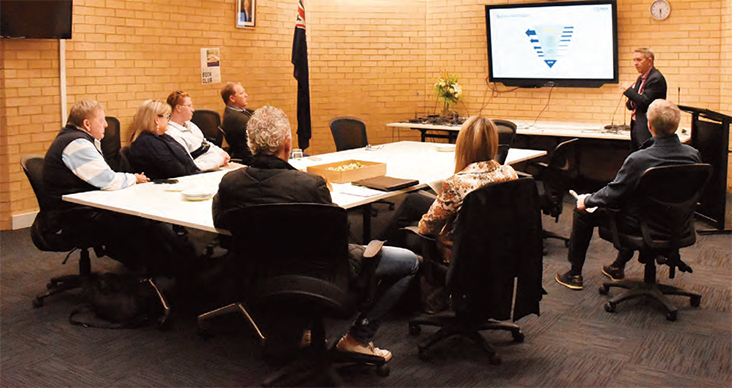
The session addressed the main aspects of the new legislation, which affects any business generating food (organic) waste such as clubs, pubs, restaurants, cafes, hospitals, aged care facilities, and similar establishments.
The legislation – part of the Protection of the Environment Legislation Amendment (FOGO Recycling) Bill 2025 – requires all food waste-generating businesses to separate waste at its source.
The mandates will be implemented in phases, beginning with larger businesses from 1 July, 2026, with councils responsible for enforcement.
Mr Ritchie said New South Wales is the first state in Australia to mandate FOGO.
“Why? Because we generate 7.6 million tonnes of food waste every year, we landfill about $20 billion dollars worth of food waste every year, it costs the economy about $37 billion because we also grow it and transport it and then we landfill it, and it contributes 3 per cent of Australia’s greenhouse gas emissions, which is a pretty significant contribution,” he said.
The National Waste Policy Action Plan aims to significantly reduce waste generation by 2030, with key targets including a 10 per cent reduction in total waste generated per person, achieving an 80 per cent resource recovery rate from all waste streams, and halving the amount of organic waste sent to landfill by the same date, which Mr Ritchie said this particular legislation is targeted towards.
By July 1, 2026, businesses such as supermarkets, institutions (hospitals, schools, etc) and hospitality venues (restaurants, cafes, etc) must have dedicated weekly FOGO collection services for their food waste, separate from general waste.
Large supermarkets will also be required to record and report food donations to charities, categorized by food type.
The new rules will be phased in, with the legislation outlining thresholds for businesses based on their weekly residual waste bin capacity.
For example, businesses with a weekly residual waste bin capacity of 3840L or more must comply from July 1, 2026. Premises with 1920L of weekly residual waste bin capacity are to start on 1 July, 2028, and premises with 660L of weekly residual waste bin capacity are to start on 1 July, 2030.
The aim is to have food waste collected separately from general waste and diverted from landfill.
“Local councils are required to enforce this,” Mr Ritchie said.
“That means checking pubs, clubs, cafes, restaurants, food courts and nursing homes, inspecting the premises for both the number and size of the bins, checking their legal contracts [with Cleanaway etc], and then making sure that supermarkets keep a record of their food donations.”
Although no government regulation has yet been released, MRA expect the compliance process will consist of seven steps for councils.
“We expect that the waste officer will go and identify the relevant businesses, visit each one and understand both bin volume plus the [pickup] frequency,” Mr Ritchie said.
“They will obtain the service contract by talking to the owner, instruct the business owner as to whether they fall under the threshold or over the threshold, issue a compliance obligation or inform them that they have a legal obligation to do this by 1 July next year, revisit the premises in a month and make sure they have got a bin.”
He said councils should communicate to businesses ahead of time and have an obligation to start getting ready.
“It starts on 1 July next year and the council’s regulatory obligation starts on that day,” Mr Ritchie said.
Peter Dale, Circular Organics Project Officer at REROC, praised Mr Ritchie for his clear and insightful presentation which he also took to councils and businesses in Gundagai, Junee, Coolamon and Holbrook last week.
With 35 years experience in environmental policy and business, Mr Ritchie is a past National Vice President and NSW President of the Waste Management and Resource Recovery Association of Australia, Chair of the Carbon Division and Director of Environment Business Australia.
“This is the sort of thing that REROC values, that we are able to, on behalf of its membership and the wider community, bring people in who have the knowledge and who can guide councils as to the correct course of action,” Mr Dale said.
Any businesses that missed the session but would like to learn more are encouraged to contact Mr Dale by email at: business@reroc.com.au or phone 02 6931 9050.

This article appeared in Narrandera Argus, 21 August 2025.
