


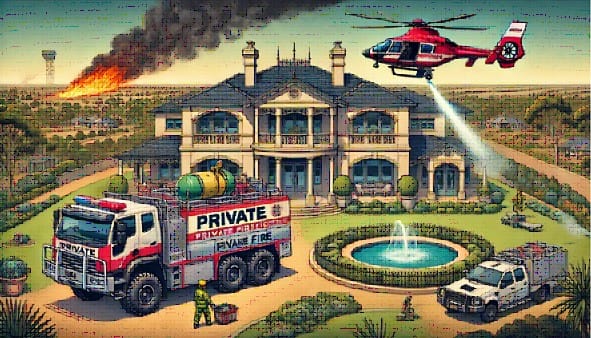
Governments exist to serve the public good by ensuring critical services like emergency response are accessible to all. Yet in a scenario both tragic and absurd, celebrities like Kim Kardashian, Kanye West, Katy Pery and billionaires like Amazon’s Jeff Bezos hired private firefighters to protect their mansions during recent wildfires.
Meanwhile, their less affluent neighbours could only watch helplessly as their homes burned to the ground as they waited in vain for the sound of the local fire brigade to come to the rescue.
This resurgence of private firefighting may seem novel, but it isn’t. In 18th- and 19th-century London, firefighting was a private enterprise run by insurance companies. Fire brigades saved only the properties of paying customers, leaving others to fend for themselves.
Australia and the United States largely avoided this model, embracing volunteer and municipal fire departments that treated firefighting as a public good. However, in California today, a combination of union intransigence, green lawfare and bureaucratic inefficiency has created a fire and emergency service mired in rules and inefficiencies.
Compounding this is their volunteers are falling away, leaving an overpaid, over-regulated, and risk averse professional fire fighting force ill-prepared to manage the escalating threat of modern wildfires. In their wake, private companies have stepped in, offering faster, more flexible, and better-equipped services—but only to those who can afford them.
While WA takes pride in its world-class professional firefighting service and strong tradition of volunteer firefighting, cracks are beginning to emerge with our firefighting services. The growing intensity and frequency of bushfires are placing immense strain on the system, raising serious questions about its sustainability.
In response, the government has taken a familiar approach: increasing funding for professional firefighters. Last year’s state budget allocated $23 million to add 60 full-time firefighters. While additional professional support is always welcome, one must ask: does this investment represent the best value for money?
If those same funds had been directed toward supporting volunteer firefighters, WA could have dramatically increased the number of boots on the ground. Property owners, who contribute $400 million annually through the Emergency Services Levy (ESL), might reasonably wonder whether they should have a greater say in how that money is spent. The ESL generates two out of every three dollars of the $600 million budget for the Department of Fire and Emergency Services (DFES), yet a staggering $280 million of that is allocated to wages—most of which support WA’s 1,249 career firefighters.
Meanwhile, WA’s 20,227 volunteer firefighters, who handle much of the state’s bushfire response, receive a fraction of the funding. The discrepancy raises important questions about priorities. With bushfire seasons becoming more dangerous and volunteer numbers continuing to decline, is this the most effective allocation of resources?
If nothing is done to reverse the decline in volunteer firefighter numbers, two outcomes are inevitable: the ESL will skyrocket to cover the cost of a dramatic increase in professional firefighters, and the wealthy will turn to private firefighting services to protect their mansions.
The key to preventing both scenarios is retaining our volunteers. Unfortunately, many are walking away, disillusioned by excessive compliance demands and onerous training requirements. Compounding the problem is an aging workforce and the problem of a generational decline in the ethos of volunteering, leaving fire brigades struggling to attract younger recruits.
This isn’t just an Australian problem; a similar trend has devastated volunteer firefighter numbers in the United States. If it continues unchecked here, the future looks grim: rural areas could become reliant on private firefighting services, accessible only to those who can afford them, leaving others vulnerable and communities exposed.
In California, union resistance to reforms such as increasing support for volunteers or modernising work practices is only adding to their problems. Volunteers, who deliver critical services at a fraction of the cost, are left wondering why they should continue to give their time for free, when the firefighter in uniform standing next to them is on double time.
To avoid going down this path the state government must act decisively to underwrite the future of our volunteer firefighters.
First and foremost, we need an all-out effort to halt the decline in volunteer ranks. While one might hope the government could reverse the trend of the past 25 years and aim for a return to 30,000 volunteer firefighters by 2030, this is likely too ambitious. A more realistic goal would be to at least maintain the current ratio of 1 bushfire volunteer per 112 people in Western Australia. To meet this target, volunteer numbers would need to rise by around 3,000 to reach 23,000 by 2030.
Achieving even this modest goal requires a complete rethink by DFES and the next government, about how to attract and retain volunteers. The solution will likely involve a mix of tangible benefits and policy reforms that make volunteering more appealing.
Here are a few ideas that could make a real difference: Doubling the value of fuel cards to help offset the cost of volunteering, especially in rural areas where volunteers often travel long distances. Payments for time spent training and the long boring job of fire mop up would be welcome by many volunteers.
Brigades should be empowered by a $1,000 annual bonus for every shed that retains an active member for 12 months. And why not offer free accommodation in Bali for volunteers who complete additional training to become fire officers or as a reward for clocking 100 hours of service?
These kinds of perks could attract younger recruits and provide meaningful recognition for experienced volunteers. Or even something as simple as offering regional-based volunteers who complete intensive training in Perth, a ticket to the footy as a reward for their time in the classroom.
The final part of the equation is the current training and compliance requirements for volunteer firefighters need a complete overhaul. While safety is paramount, the system needs to recognise prior experience along with reducing the time required for each ticket.
Let’s face it: hiring more professionals is far more expensive than investing in volunteers. If Western Australia is serious about addressing its growing fire risks, the share of the Emergency Services Levy allocated to volunteers must increase.
Career firefighters and DFES staff play a critical role in managing WA’s fire risk, but allowing volunteer numbers to continue falling will come at a steep cost. Over time, this decline will either force the ESL to skyrocket to fund more full-time professionals or, in a worst-case scenario, lead to the breakdown of public firefighting systems altogether.
History tells us that when the public or volunteer fire brigade cannot be relied on the wealthy will hire private firefighting crews to protect their homes, leaving everyone else to fend for themselves. This is not a path WA can afford to go down—not financially, and certainly not morally. Investing in volunteers now is the only way to ensure a sustainable, equitable, and effective bushfire response system for all Western Australians.


Unfortunately Trevor seems to have a fundamental lack of knowledge about bushfire fighting in WA if he believes that DFES is the only professional bushfire fighting organisation in WA. DBCA actually provides, or did provide, the bulk of the professional bushfire fighting capacity in the State. Unfortunately, due to the ESL, which DBCA does not receive, this agency has withered in comparison to DFES to the point that people, like Trevor, do not even seem to know it exists. In many cases volunteers are now better equipped than DBCA and do provide a very valuable and important first response role in suppression of small bushfires. However they cannot replace a properly funded professional bushfire fighting organisation such as DBCA with the numbers, training and experience required to run and constantly resource complex incidents, operate trucks and heavy machinery on steep and forested fire line (a specialist role), crew firebombing, incendiary or spotter aircraft, fill fulltime availability rosters and plan/conduct large mitigation burns amongst other things. Good on you Trevor for standing up for volunteers but DBCA needs your support too if you are concerned about the future of rural firefighting.