

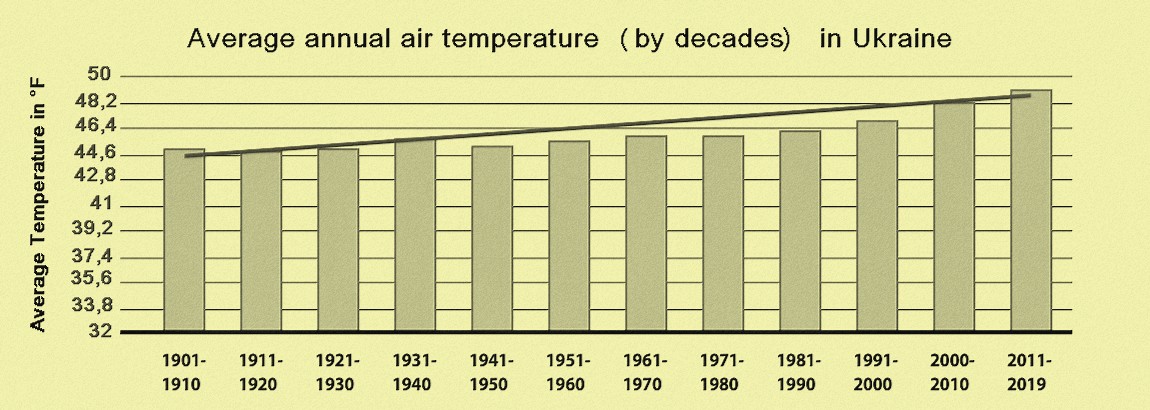
Ukraine is at the epicentre of global warming. The average air temperature in the country is rising faster than the world average. And Ukraine is the record holder for average annual temperatures in Europe. This significantly affects the country’s agriculture. In the medium term, global warming may provide some benefits for Ukrainian farmers. However, in the long term, this phenomenon will greatly complicate farming in Ukraine. Therefore, even during the war, Ukrainian society is trying to adapt agriculture, villages and cities to the consequences of global warming.
Global warming and Ukraine
From 1880 to 2012, the average increase in temperature on the planet was 0.85 °C.1 However, in Ukraine, air warming is happening faster. From 1901 to 2011, this indicator increased by almost 2 °C. And in recent years, this process has accelerated. According to the calculations of climatologists, the average rate of warming in Ukraine is about 0.4 °C in 10 years.2
It is not surprising that in 2024, Ukraine turned out to be the leader in Europe in terms of air temperature dynamics.3 The country was the leader in deviations from the average temperature, as well as in the average temperature. In some areas, the air temperature reached 55 °C or 130 °F.4 This summer was the hottest summer in the entire history of air temperature observations in Ukraine!
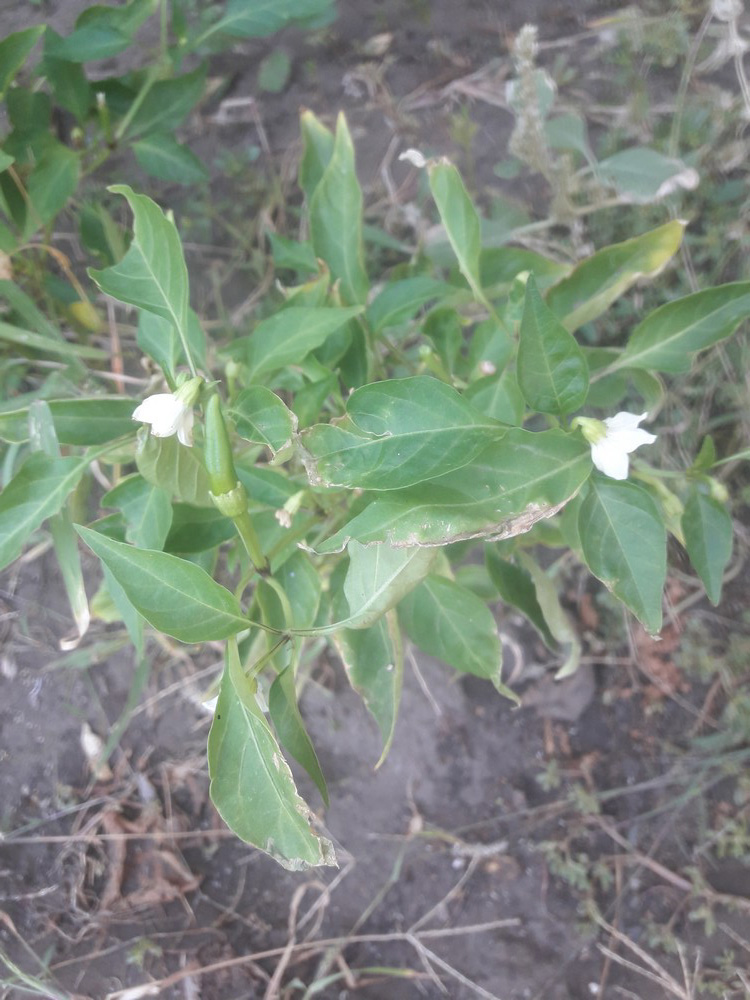
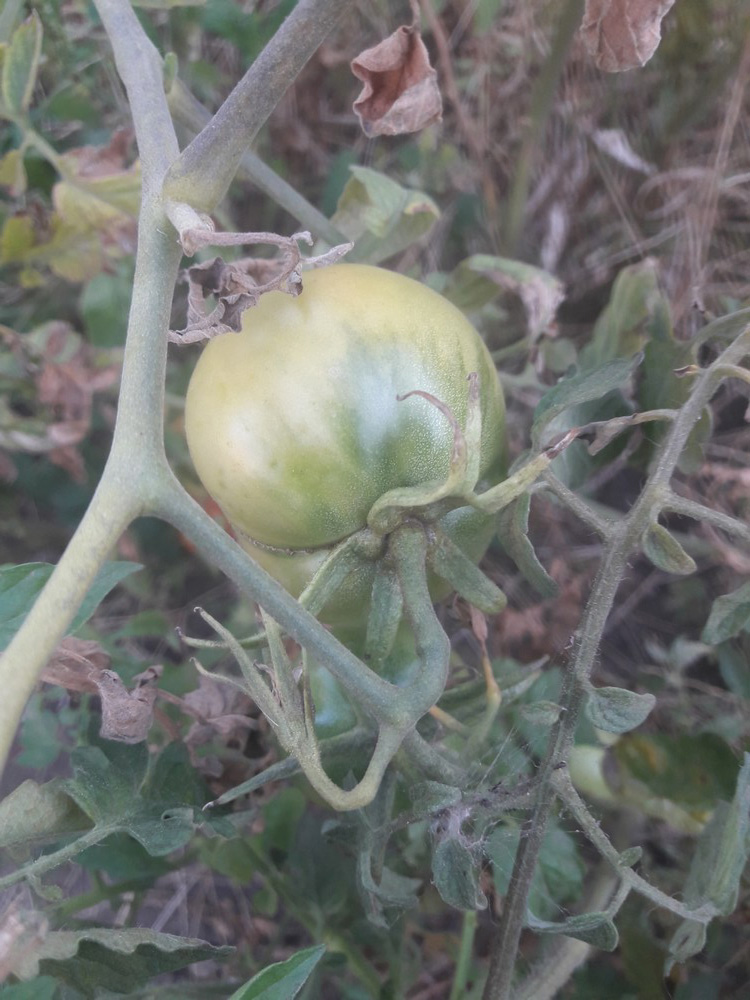
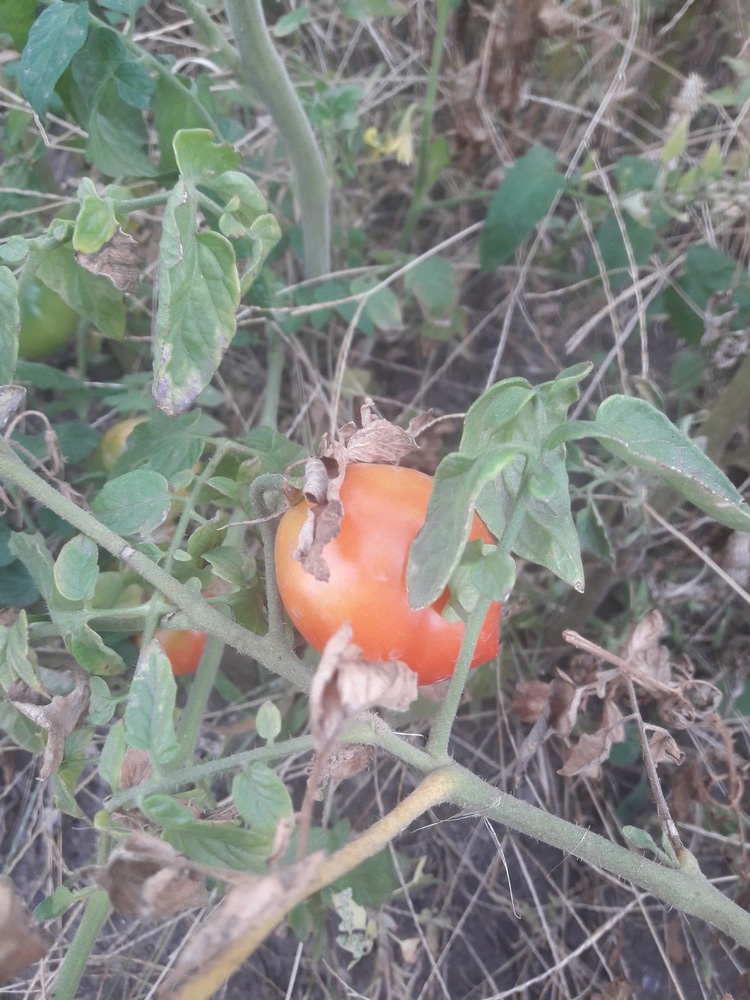
Although it is almost mid-October, our hot peppers are still blooming. Lots of hot peppers. And lots of green tomatoes. Lots of ripe tomatoes.
Photos: Pavel Kuliuk
Ukrainian society is alarmed by what is happening; 93 per cent of the population believes that the country needs to adapt to climate change.5 These changes should concern not only populated areas, but also agriculture. This sector of the economy is particularly affected by global warming. With the start of the war with Russia, the pressure of climate problems on Ukrainian agriculture has increased. After all, the Russian invasion creates significant greenhouse gas emissions.
The total damage to the climate caused by the Russian Federation during the two years of its full-scale invasion of Ukraine is US$32 billion. During the first 12 months of Russia’s full-scale invasion of Ukraine, 120 million tons of carbon dioxide were emitted. However, in the 24 months since the invasion, emissions have increased to 175 million tons of carbon dioxide. This exceeds the annual emissions of an industrialised country like the Netherlands, exceeds the emissions from putting 90 million new gasoline cars on the road or, for example, building 260 coal-fired power plants with a capacity of 200MW each.6
The impact of the war’s consequences can be assessed in the near future. However, even pre-war studies indicate major changes in Ukrainian agriculture due to global warming. There are positive and negative changes.
Negative changes
In Ukraine, the duration of active vegetation has increased by an average of 10 days. By 2030, the period of growth and development of heat-loving crops is likely to be extended by another 10 days. There is a clear trend towards a decrease in precipitation in winter by 3-17 per cent, and almost unchanged in summer and spring. There is an increase in arid areas and an increase in the frequency of droughts. The number of summer and autumn droughts may increase by 15-30 per cent by 2030 .
Dry spells occur in the northern and eastern regions of Ukraine. This is an atypical phenomenon for our region. Hail falls at times of the year that are not typical for this phenomenon. This provokes freezing of crops in the spring and autumn months. The risks of freezing and death of crops from a long-term occurrence of ground ice crust in Ukraine remain.1
Significant warming in winter, slight soil freezing and early onset of spring processes contribute to an increase in the number of pests and diseases of agricultural crops and forests. According to experts, in the period 2011-2016 they increased by almost 25 per cent compared to the previous five years and continue to increase exponentially. In the future, the migration of pests, an increase in their numbers and the number of generations is likely. In addition, the nature of precipitation changes, namely, the number of ineffective heavy downpours increases. Such rains after long dry periods do more harm than good.2
Positive changes
The temperature in winter increased by 1.5-2 °C and the depth of soil freezing decreased to 20-70 cm, which is a favorable factor for the absorption of winter precipitation by the soil and the formation of sufficient soil moisture in the spring.
Winter wheat will remain the most productive in the coming years. The yield will increase by 20-30 per cent. By 2030, it is possible to increase the productivity of spring barley by an average of 15-20 per cent. However, in the southern and southeastern regions, its harvest may decrease by 15-25 per cent.
By 2030, even in northern Polesie, early and mid-season sunflower varieties will be able to fully ripen. This makes it possible to get a large sunflower harvest.
At the same time, a steady decrease in the sunflower harvest is possible in the steppe zone. This will happen due to deterioration in soil moisture (to reduce losses in this zone, it is advisable to sow sunflower before winter).
Favorable conditions for growing soybeans will remain until 2030 in all climatic zones of the country, except for the northern and western regions of Polesie. In the steppe, the risk of an expected crop shortfall will be 20-30 per cent.
The area of ”‹”‹industrial cultivation of fruits and berries is gradually spreading to the north and west, receiving the amount of heat necessary for ripening. By 2030, for the sub-sector of fruits and berries, there is a risk of decrease in yield due to the expenditure of plant resources on adaptation to temperature changes and recovery from stress; an increase in the frequency of damage from frost, hail and heavy rain.
By 2030, we can expect changes in the structure of vegetable crop areas, a transition to late-ripening and more productive varieties of traditional vegetables. An increase in moisture deficit will have a negative impact on potato and sugar beet yields. This will especially happen in the steppe. In the future, we can expect an expansion of the zone favorable for eggplants, sweet peppers and tomatoes.1
Of course, a positive consequence of climate change is the significant warming of the winter months, and, accordingly, the reduction in the risk of winter crops freezing. The winter period has shortened by almost a month and this creates conditions for earlier sowing of spring crops. The period of active vegetation of agricultural crops has already extended by 10 days or more. These are additional opportunities for growing all types of heat-loving agricultural crops.2
Some benefits from warming are likely to be short-lived. Within 15 to 20 years, significant reductions in the harvest of most crops are likely due to increased frequency and severity of droughts.2
Counteracting the negative effects of global warming
The fight against the negative consequences of climate change takes place on several levels. The government of the country has prepared a special strategy for this. The Ministry of Environment has developed a draft Climate Policy Strategy until 2035 and an operational plan, which were presented in Brussels and at the COP28 Climate Conference. In the near future, this strategy will be submitted to the Government for consideration. The strategy will become one of the main documents containing the goals and main methods of combating climate warming.7
Public organisations, research institutes and large agricultural holdings are also fighting global warming. Thanks to these organisations, practical recommendations for farmers have been developed. Here are some of those recommendations:
- Find an opportunity for the production and use of renewable energy sources on the farm (heat and electricity produced with the help of wind, solar, biomass, biogas or small hydroelectric plants);
- Use efficient heating and lighting in buildings;
- Reduce the amount of fuel consumed by agricultural machinery and machines, use energy-saving technologies;
- After harvesting the main agricultural crops, do not leave soil bare, but grow low-growing plants and plants that retain biogenic elements;
- Grow perennial grasses as part of crop rotation;
- Reduce ploughing and grow grass on peat soils. Allow swamps to remain swamps, because when converted to agricultural land, swamps release large volumes of greenhouse gases;
- Use fertilisers in the optimal period of time and in the amount that can be assimilated by agricultural crops;
- Correct use of manure (storage, use during the growing season, immediate ploughing after distribution on the field) to reduce evaporation and leaching of biogens;
- Prevent water erosion by creating anti-erosion plantings. Grow leguminous siderates (peas, alfalfa, forage beans, clover, lupins) as part of a crop rotation to obtain nitrogen. Grow cereal siderates (oats, wheat, rye, sorghum), which increase the amount of biogens in the soil, suppress weeds, structure and loosen the soil. Due to this, the need for mineral fertilisers decreases;
- Grow groundcover crops (radish, mustard), which clean the soil of nematodes, wireworms and pathogenic microorganisms, enrich the soil with a complex of useful substances and are antagonists of the evil wheatgrass. These plants reduce soil erosion due to heavy rains and floods and help better retain moisture in the soil during drought;
- Practice the no-till system and other restorative agricultural practices;
- Practice crop diversification, which helps not only to improve the fertility of the soil, but also to obtain a stable profit from the cultivation of such crops as flax, rape and sunflower;
- Increase biodiversity through crop rotation (alternating several crops in time and on the territory) as well as diversification of crop cultivation, which will be an insurance in the event of the death of one of the crops;
- Maintain agroforestry plantations on farms in proper condition, and in their absence – create new ones;
- Consider creating perennial plantations (orchards, plantations of nut crops, etc.), while giving preference to domestic zoned varieties;
- Use drip irrigation, which, compared to other types of irrigation, uses water more efficiently and is an adaptation measure to climate warming.2
Ukrainian rural residents are fighting the consequences of global warming on their own. Here’s what Ukrainian rural residents told Australian Rural & Regional News.
Elena Sklyarova (Kramatorsk):
This year, due to the intense heat, the pumpkin could not bear fruit in the open area of ”‹”‹the garden. The plant grew for about 2 months to the raspberry bushes or trees. There was a shadow there. In that place, the pumpkin began to bear fruit. But it happened too late. That is why the pumpkins are small. Also, this year, the tomatoes and cucumbers were burnt in the sun. This is even though these plants were watered every evening. To avoid these problems, shade will be made for the tomatoes and cucumbers next year. A special canopy will be made for this. The pumpkins will be planted in the shade of large trees. To create shade for the plants, I will have to dig flower beds in unusual places. For example, flower beds will be made along fences and buildings. I will also plant trees between the flower beds. This will make it possible to create shade.
Svetlana Khromova (Kramatorsk)
The problem is the leaves on the trees. Despite the fact that it is now the end of September, the leaves on the trees do not turn yellow. This is worrying. Since it is very harmful for trees to meet frosts with leaves on the branches. On young trees planted last year, the leaves can be removed by hand. But for large trees, it is necessary to use defoliant chemicals or a 7 per cent solution of urea.
This spring, the trees and shrubs bloomed too early. The bees were not yet vigorous after hibernation. Therefore, the bees were not ready to pollinate the plants so early. As a result, the harvest of many plants has greatly decreased. Next year, if the plants bloom again too early, it will be necessary to specially attract bees to the garden. To do this, people need to spray the plants in the garden with a honey solution. Three tablespoons of honey per one gallon of water. The garden should be sprayed in the morning. This will help attract bees living at a distance of 2-3 km from the garden.
The gardening schedule will also be changed. Due to the lack of rain, the trees had to be watered even in September. Although previously watering stopped in mid-August. This made it difficult to dig flowerbeds. Therefore, next year we need to start digging flowerbeds not at the end of September as usual. But at the beginning of the month. Since, due to watering the trees, digging flowerbeds will take more time.
Oksana Pitchenko (Rivne)
Mulching of the soil will be used more actively. We will put branches of coniferous trees, tree bark, cones, conifer needles under the trunks of plants. This allows us to retain moisture in the soil. This year we did not do this under all plants. Those plants where the soil was mulched grew better.
All these actions are very simple and do not require large investments or special knowledge. This is the so-called folk wisdom. Whether this will be enough to protect the garden from global warming will be shown by the next gardening season. In the meantime, the heat is not decreasing. This creates a surreal picture. At the end of September, pumpkin, squash, sweet and hot peppers are blooming in my garden. And in the south of Ukraine, fruit trees have blossomed en masse. Natural anomalies continue.8
References
1. https://uga.ua/meanings/yak-vplivaye-zmina-klimatu-na-vedennya-silskogo-gospodarstva-v-ukrayini
2. https://www.apd-ukraine.de/fileadmin/user_upload/Hanbuecher/Zmina_klimatu_v_Ukrajini_web3.pdf
3. https://climatebook.gr/ioulios-2024-o-thermoteros-sta-chronika-ton-katagrafon-sto-megalytero-meros-ton-valkanion/
4. https://rumble.com/v57f0jo-130f-hot.html
5. https://ecoaction.org.ua/kataloh-pryrodooriientovanykh-rishen.html
6. https://ecoaction.org.ua/vplyv-ros-vijny-na-klimat2024.html
7. https://mepr.gov.ua/vplyv-klimatychnyh-zmin-na-silske-gospodarstvo-ta-prodovolchu-bezpeku-krayiny-potrebuye-vprovadzhennya-adaptatsijnyh-zahodiv-na-riznyh-rivnyah-vid-natsionalnogo-do-mistsevogo/
8. https://www.unian.net/ecology/v-odesskoy-oblasti-massovo-zacveli-grushi-uchenyy-obyasnil-pochemu-eto-ploho-foto-novosti-odessy-12768087.html
