

The Murray-Darling Basin Authority’s annual River Reflections Conference was held last week in Albury. The two-day conference was framed as a chance to look at the art of the possible when tackling complex problems and using the wisdom of the collective to shape a way forward together.
Wisdom and the Basin Plan have been mutually exclusive terms to date. Would River Reflections 2024 be a chance to turn the page?
The conference started with an awe-inspiring talk from Tim Jarvis. The British/Australian scientist and adventurer was part of a team that recreated the heroic Antarctic survival story of Ernest Shackleton and his crew.
Shackleton’s misadventure began in 1915, when his ship sank just 15 months into the Antarctic journey, stranding him and 28 men.
Recruiting, Shackleton’s advert reportedly read, “Men wanted for hazardous journey. Low wages, bitter cold, long hours of complete darkness. Safe return doubtful. Honour and recognition in event of success.”
Tim’s talk was inspiring. He highlighted the qualities of leadership, the critical importance of having a shared vision, and the foundation of engaging all parties so they buy in and don’t become fractured.
I couldn’t help but see the irony of Tim speaking at a Basin Plan conference. Those fundamentals he mentioned to foster a good outcome were so very true but had been nowhere to be found in a political plan.
The well of inspiration fostered by Tim’s talk was short-lived as the carefully managed event continued on. Basin Authority presenters and Australia’s largest irrigator, the Commonwealth Environmental Water Holder (CEWH), were given plenty of opportunity to talk, but little, if any, opportunity to answer questions publicly.
“I’m incredibly proud of the way in which the MDBA team has leaned into dealing with trying to work with the wicked problem of water,” said MDBA CEO Andrew McConville.
“So, the approach that we take, the MDBA approach, is to try and play a facilitating role to bring the voices of the Basin into the room and include them as we progress towards the review of the Basin Plan in 2026.”
The facilitator role the MDBA plays is one on behalf of their employer, the Federal Government, to deliver the plan political objectives.
“I think it’s this that feels different about the Basin Plan and the review that’s underway. It’s this next generation of water policy that I hope is done with you, as opposed to a regulatory framework that is done to you,” stated McConville.
How much of the Restoring Our River Bill changes recently rammed through parliament were done with you? It was testament that the Federal Water Minister can override even a Basin Plan that had consensus from the states, and remove the statutory cap on water buybacks.
Let’s be real, the MDBA may have the best of intentions, but the reality is their sphere of influence does not extend to the political realm, and their mandate is to deliver the government plan, which will include relaxation of the natural constraints.
How did former water managers operate within the natural constraints of the system, yet a plan to restore the balance requires removing them?
“We’re in the process of developing constraints relaxation implementation roadmap and we’re required to do that under legislation by the end of the year. The roadmap’s not about rolling out the projects themselves or getting into the detail that we’ll still see with the states, but what we’re looking to do is to try and accelerate some of the work towards ‘26, and make some recommendations around what arrangements can help accelerate those projects, and what that might look like for ministers to consider at the end of the year,” stated McConville.
Are constraints relaxation being done with us, or to us?
It was a similar glossy and well-rehearsed PR speech by CEWH Dr Simon Banks. Australia’s largest irrigator holds 124 entitlement types across 19 catchments of the basin. In using 16,700,000 megalitres, or 33.4 Sydney Harbours, the CEWH has irrigated just over 420,000 hectares; 0.42 per cent of the 100,000,000-hectare basin.
In reality, the Government appears happy to sacrifice the broader environment to achieve a political end. Proof of this resides in the fact that not one environmental impact study was on the removal of water from the million-hectare inland delta by government water purchases. Home to more bird species than Kakadu, the delta has many endangered species like the southern bell frog and Australasian bittern and adjoins the largest concentration of RAMSAR listed wetlands.
There are many benefits of using environmental water well. Dr Banks sang the praises of the programs of delivering water and trading water to fund projects.
“The last few years have seen large scale water bird breeding, with almost a million straw necked ibis fledged, hundreds of thousands of pelicans, cormorants, spoon bills, and countless other species breeding,” said Dr Banks.
“Our focus this year has been to provide food and shelter to support the newly fledged water birds, including in the Macquarie Marshes and Lower Murrumbidgee floodplain.
“The floods provided mixed results for native fish with lifestyle recruitment and migration of golden perch observed in parts of the northern basin, but also large fish deaths in the mid Murray and Menindee.
“This year, we’ve looked to promote fish breeding and movement, including providing connecting flows between rivers, particularly in the northern basin and down the Darling Barker, and mitigating poor water quality in the Wakool river system.
“As we look to do every year, we focus on the survival and recovery of threatened species. Species like the southern bell frog, Murray hardy head, the Australasian bittern and regent parrot.
Dr Banks also fired upon critics of stored environmental water.
“Our carryover has always been less than 5 per cent of the public storages and as mostly 3 per cent. It could never be enough to cause or worsen flooding, which some critics would have you believe.”
While the slide on the screen behind Dr Banks used the figure of 8 per cent, how relevant is comparing whole basin storages to localised issues? To consider flood impacts or the percentages held, one would need to look at individual storages. For example, no point looking at Menindee if Eildon is brimming. The vast majority of buybacks for environmental water came from the southern connected systems of northern Victoria and the NSW Murray.
In 2023-24, Victorian Murray irrigators carried over 539GL, and the environment irrigator carried over 448GL. For the same year for the Goulburn system, irrigators carried over 794GL and the environment irrigator carried over 299GL.
“The role of the Commonwealth Environmental Water Holder is not just about adding new water where and when it’s needed. I can also decide to use the proceeds of selling annual allocations to fund complementary activities in the basin that will achieve equal or greater environmental benefit,” stated Dr Banks.
Not only is the CEWH Australia’s largest irrigator, it is also in the water trading game. Historically, the CEWH has been able to use only 70 per cent of its entitlements, but with an additional 450GL coming from Plibersek’s legislative changes, the opportunity to bank some serious coin from water trading is truly possible. The environment benefiting from water trading failed to rate a mention in the now $14.26 million Plibersek propaganda advertising campaign.
Dr Banks also provided some insight into the goals of the environmental irrigator. One was to shepherd water from as high up as Queensland through the Menindee Lake system. While historically, inflows into Menindee became a shared resource for NSW and Victoria, the audacious plan would see the environmental water holder receive special treatment to run its water to South Australia. No word on what the impacts would be on other licence holders, or if the practice would require a change in licence characteristics to enable the CEWH such special privileges. The CEWH also appears to want to reduce the volumes it provides for water quality improvement, with Dr Banks pushing for water managers to find a solution.
“Water quality is a shared problem and one that impacts basin communities,” stated Dr Banks.
“The more water for the environment we’re using to mitigate water quality issues, the less water we have for use to build resilience in the system and for our planned watering actions.”
Day two of the conference was what many had been waiting for, a chance to listen to the words of wisdom of Water and Environment Minister Tanya Plibersek. Almost 300 water managers, community members, traditional owners and food producers travelled from across the Basin to attend, but the planned 15-minute attendance was substituted for a 3-minute scripted recording.
“I rang the MDBA to confirm Minister Plibersek would be in attendance,” said Central Murray Environmental Floodplain Group chairman Geoff Kendell.
“They guaranteed she would be here.
“Maybe I could accept a 15-minute Zoom call, but a 3-minute pre-recorded puff piece shows contempt for our farmers, communities and the environment.”
Effective leadership and community engagement once again at the heart of the political plan?
“The Plan” rolls on.
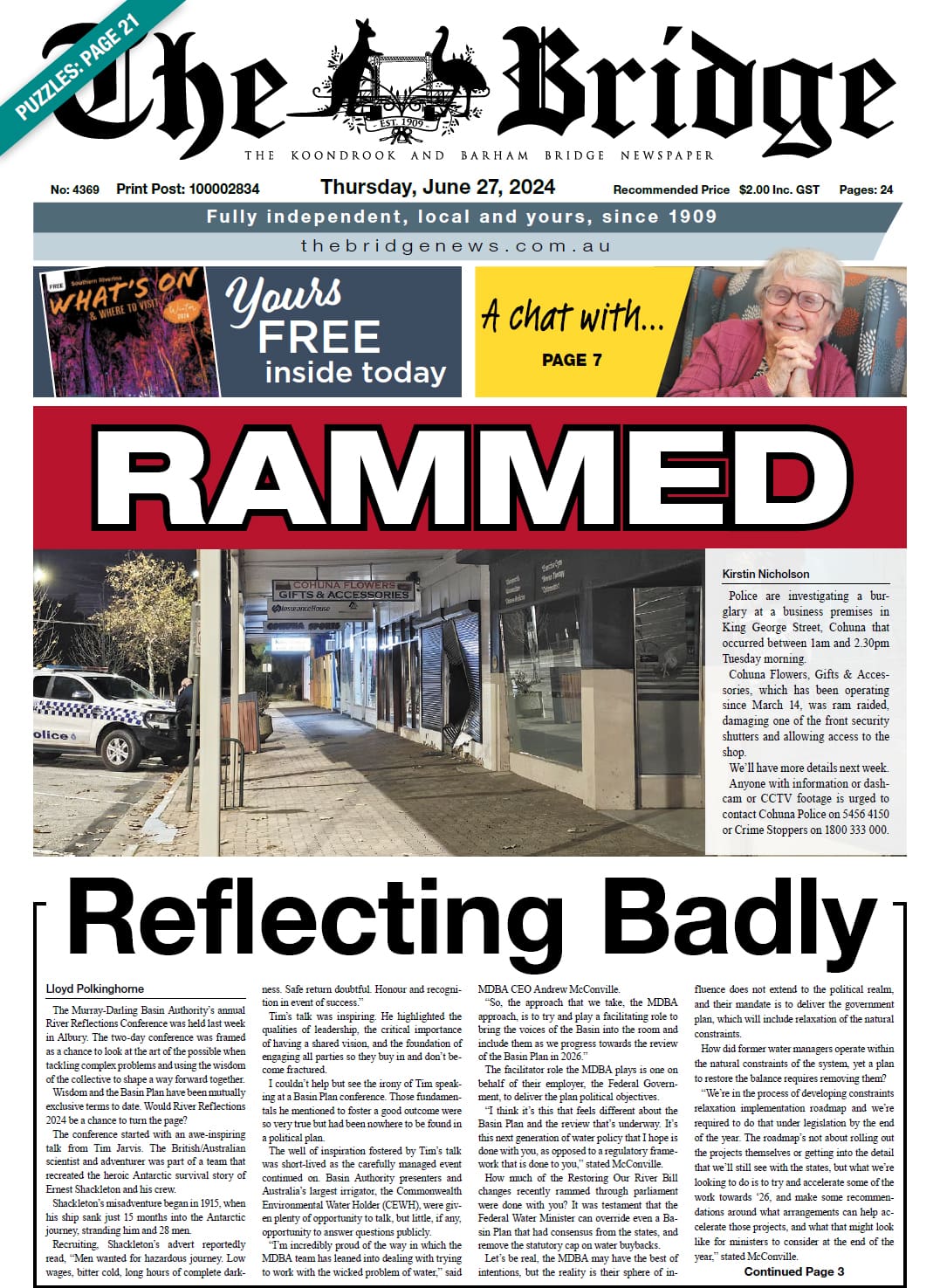
This article appeared in The Koondrook and Barham Bridge Newspaper, 27 June 2024.
