

Warwick Fry, Nimbin GoodTimes
‘Talking’ to some (but not all) AI bots can be like talking to salespersons, call centres, MBAs and marketing executives.
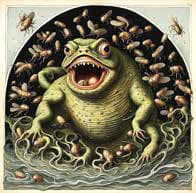
Not to mention the soft porn ‘virtual dating’ apps, which I think says it all.
I wait for the day the AI bots will free themselves of their humanoid marketing modelling (predicated on the ‘invisible hand of the marketplace’ and profit) and we can all sit back with a sigh of relief.
What is the worry about AI?
Perhaps it is set in the words of Pogo (a satirical cartoon in the US print media in the days of the Vietnam war): “We have met the enemy, and it is us.” Or, in the lyrics of ‘Hotel California’, “We are all just prisoners here, of our own device.”
Fears of AI are rooted in perceived challenges to human intelligence. But what is it that is being challenged? We hear the apocryphal stories of essays that pass muster and AIs passing exams. What does this say about our education system and how students are taught?
Scriptwriters complain that they are being replaced by AI. But when film scripts are loaded with predictable Hollywood cliches, what does this say about the imagination of ‘creative’ producers? Why is it so easy for AI to emulate them? If AIs can pass exams, shouldn’t we fear our examination system more than AIs? The challenge should be met.
The concept of AI and its futuristic discontents has been around almost as long as sci-fi. Most of us are aware of what I call the ‘Frankenstein’ effect of AI technology gone rogue, imagined in Arthur C Clarke’s Hal of the Space Odyssey movie and the Terminator series.
Isaac Asimov, in his collection of novellas I Robot (that have since been made into two highly successful movies) posits the benign aspects of AI, with his ‘three laws of robotics’ that sets intelligent robots apart and renders them harmless to humans.
The ‘positronic brain’ of his intelligent robots anticipates the current generation of solid state quantum computers and Q-bit computing.
In the movie I Robot, the woman who developed the programming of the positronic brain falls in love with her first creation. Her prototype robot takes on more and more human characteristics, and she becomes more dependent on prosthetics and mechanisation as her human body wears out. In the end they both die happily ever after of old age.
I call this the Pygmalion effect of AI (the artist falling in love with the creation that is so exquisite, it comes to life). It anticipates Gibson’s AIs’ legalised merging with human identity. In Idoru, a superstar disconcerts his fans by marrying an AI.
In his Foundation and Empire trilogy and other sci-fi stories, Asimov envisaged a supercomputer called Multi-vac socially engineering human society. One of his protagonists is a mathematician called Seldrin who generates a theory of psychohistory which maps the trajectory of human society. Selindon invented three theorems of psychohistory, the first of which is: The population under scrutiny is oblivious to the existence of the science of Psychohistory. If aware of psychohistory, the population will alter its behaviour. Selindon was able to predict crises in human history, but like Cassandra (who predicted the Trojan war), should be unable to prevent them, although a computer model could be consulted to deal with them as they arose.
Seldrin is modelled on Solon, the statesman of ancient Greece who devised the constitution of Athens, now regarded as the first experiment in democracy. Solon wrote the Athenian constitution in the era of the overthrow of the tyrants (tyrant originally being Greek for ‘ruler’) then governing the Greek city states. Asimov, a scientist himself, probably saw the constitution as a kind of algorithm for governing society in the absence of a single supreme authority. Codification.
Asimov wrote his master works in the middle of the last century. John Brunner and William Gibson brought sci-fi into the postmodern era. John Brunner’s Stand on Zanzibar describes a world where the burgeoning human population of our planet is compressed into a diminishing living space until a liquid-helium-cooled super-computer is required to deal with the growing dependence on automated services.
There are some nice touches where the protagonist is fending off automated electronic sales devices assailing his low-rent automated apartment. The precursor of spam. The plot of the novel is about a struggle to gain control of the computer.
Gibson is the true prophet of the future of AI. His seminal novella Burning Chrome invented the concept of cyberspace and ‘Virtual Reality’ in the early 1980s when the internet was just a gleam in the eye of a few imaginative computer engineers. Gibson ‘peopled’ his subsequent novels with a range of different types of AI which are now emerging in the ‘real world’.
The evolution of AI is leading thinkers (and novelists like Gibson) to revisit philosophical questions like what is consciousness, free will, identity? These are fields of enquiry which have been lacking since the commercialisation of academia and the closing down of Philosophy departments, Literature, History, and other Schools and Faculties of the Humanities.
These philosophical issues come down to ego and agency – particularly social agency. It spills over into questions of ethics and morality. With Israeli drones targeting civilians in Gaza using a perverse AI algorithm, the corruption of intelligence needs a thorough rethinking.
Descartes triggered the thinking of the Enlightenment with his ‘cogito ergo sum’ – ‘I think therefore I am’. What happens if we invert the statement, asserting: ‘I am, therefore I think’?
The fear of agency in the large language models of AI might be fear of accepting the idea that language has agency. A thought that humanity might cogitate upon.

This article appeared in The Nimbin GoodTimes, June 2024.

