

Property Rights Australia (PRA), Media Release, 2 March 2026
Property Rights Australia says the Federal government’s major overhaul of environmental law duplicating the traditional State role was always going to be a problem for an under resourced Department of Climate Change, Energy, the Environment and Water DCCEEW.
Compounding the problem is a surge in complaints regarding alleged “illegal tree clearing”, placing increasing pressure on both regulators and rural landowners.
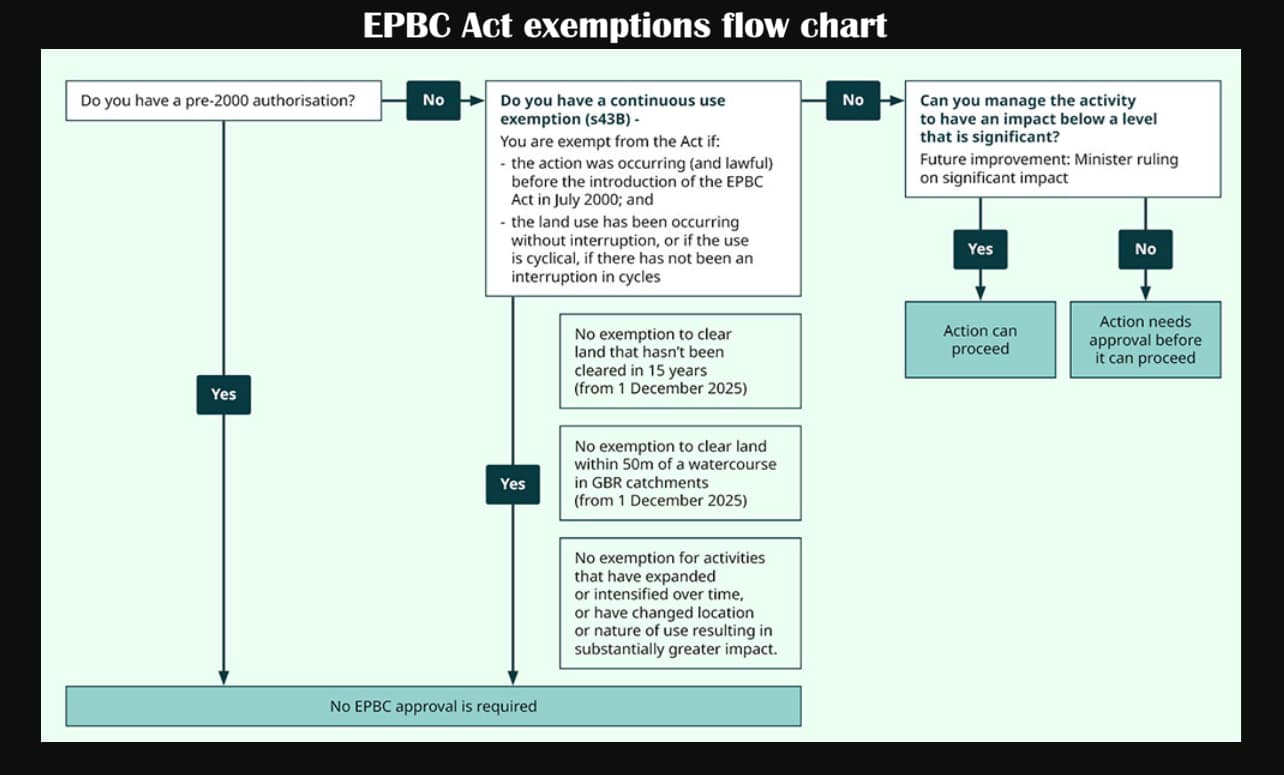
EPBC Act exemptions flow chart https://www.dcceew.gov.au/environment/epbc/epbc-act-reform/updates-agricultural-action-exemptions-epbc-act.
PRA Chair Dale Stiller said the department appears to be struggling with the growing number of often frivolous complaints lodged across the country, whereby every allegation must be assessed.
“There are growing indications that the Federal Department of Environment is being overwhelmed by complaints alleging illegal vegetation clearing,” Mr Stiller said. “Many in the agricultural sector are concerned that this could reflect organized campaigns by activist groups to intimidate landowners and discourage legitimate vegetation management.”
Mr Stiller is concerned that recent public commentary risks misleading the public about the intent of the federal EPBC Act. “Although the changes to the EPBC Act currently lack full clarity with the yet to be released defined standards; there is no blanket ban on agricultural land management for normal farming operations, despite what some activists claim,” he said. “Important exemptions for ongoing agricultural activities remain in place, except for vegetation older than 15 years nation-wide and within 50 metres of Great Barrier Reef watercourses.”
On January 19, DCCEEW published ‘Updates to agricultural action exemptions under the EPBC Act’ which landowners can refer to.
PRA warns that the rapid escalation in complaints could lead to unintended consequences. Mr Stiller noted, “There is a real risk that investigations could be undertaken by personnel with environmental management degrees but limited practical knowledge of agriculture or rural land management,” he said. “This raises the possibility that some landowners could be unfairly investigated or fined.”
He encouraged landowners to document reasons for their actions backed by photographic evidence and remain calm if contacted by regulators. “Farmers should not panic if they receive an infringement notice or inquiry for further information. This is not the end of the process,” he said. “Landowners have the right to contest notices, request review or judicial review, and to seek professional advice from rural consultancies.”
Property Rights Australia will continue to monitor the situation, advocating strongly for landowners and standing firm in defending their property rights.