

Two articles regarding the jarrah forest in the south-west of Western Australia by Frank Batini, professional forester and environmental consultant, have been published in peer-reviewed journals.
In Frank’s words, “Each one challenges an established ‘truth’ about the effects of climate change in the south-west of Western Australia. This forest has survived for some four to five million years. I am confident it can survive for a few decades longer. We humans must recognise that the ecosystem is never static, and be able to live with and accept some level of change.”
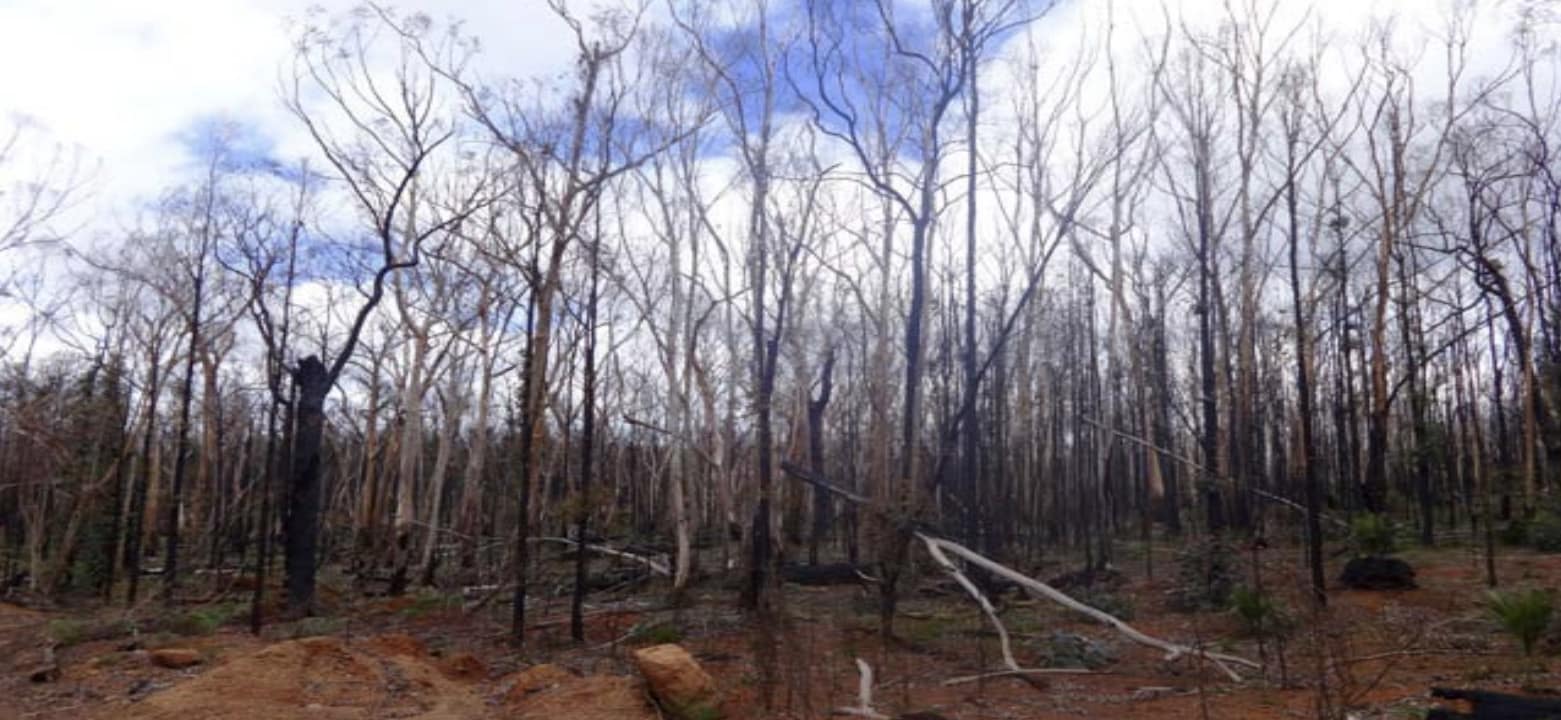
Photo: Frank Batini, March 2016.
Frank’s brief summary of each article:
- “A wildfire burning over five days would do more damage to vegetation and biodiversity in the northern jarrah forest than five decades of climate change has done;
- In 2011, crown scorch and some tree deaths on a few sites with shallow soil led to alarmist claims that the jarrah forest was on the verge of collapse. These claims were wrong. In December 2025 the northern jarrah forest was very healthy.”
Five Decades of Hydrological, Vegetation and Biodiversity Responses to Climate Change in a Southwestern Australian Jarrah (Eucalyptus marginata) forest (1972-2024)
by Frank Batini
Murdoch University
Global Journal of Science Frontier Research: H Environment & Earth Science
Volume 25 Issue 3 Version 1.0 Year 2025
Type: Double Blind Peer Reviewed International Research Journal
Publisher: Global Journals I Online ISSN: 2249-4626 & Print ISSN: 0975-5896
Summary
Water is a key driver for many ecosystem processes. The integration of various sets of data for the 2000 ha 31 Mile Brook catchment allows an holistic evaluation of the responses by this ecosystem to substantial changes in hydrology. Excellent baselines for hydrology and vegetation are available from 1972.
From the late 1960’s there has been a major reduction in rainfall in the South-West of Western Australia and an even greater decline in stream flow. Modelling simulations closely matched the observed drying trends in stream flow, flow days and groundwater depth. The model was then used to estimate the impact of thinning treatments on these values. Between 2004 and 2010, the estimated evapotranspiration matched the average rainfall and soil moisture storage fell.
Estimates of Leaf Area (LAI) show steady canopy growth after good rainfall years (to 1.5) and then a substantial decline, as a result of the very dry 2010 winter. Crown scorch and some tree deaths on shallow soils were observed in autumn 2011 and again in 2024. Detailed mapping of species composition in 1972 and remapping in 2012 showed only a slight xeric shift. In 2024, the tree stratum was healthy, but small changes in composition were observed, some as the result of a prescribed burn, others due to drought.
Aquatic biodiversity between 1984 and 2010 reveal shifts in faunal assemblages, species richness and abundance, but only for a few species that have longer life cycles. A range of terrestrial biota show little change, as the understorey vegetation on which they depend for food and shelter is still healthy.
So far, this ecosystem has shown remarkable resilience to a changing climate. Modelling suggests that thinning the tree stratum to a basal area of 14 would benefit soil moisture and increase stream flow. Thinning for ecosystem health is now approved in the Forest Management Plan (DBCA 2024). Recommendations for ongoing management and research are made.
Read the full article in Global Journals.
Is the jarrah (Eucalyptus marginata) forest under threat from a changing climate?
F. Batini
Private Consultant
Australian Forestry, 2025, Vol 88, No. 1, 50-56
https://doi.org/10.1080/00049158.2025.2548130
Abstract
In summer 2011 and again in 2024 there was limited but noticeable drought scorch and some deaths of jarrah on sites with shallow soil in the northern jarrah forest of Western Australia.
Resulting academic and media comment immediately linked these deaths to human-induced climate change. The Intergovernmental Panel for Climate Change in their 6th assessment report, dated 2022, listed the northern jarrah (Eucalyptus marginata) forest at a ‘key risk of transition or collapse from drought (high level of confidence)’. Consequently this finding was accepted in the development of the Western Australian Government’s Forest Management Plan (2024 to 2033) covering south-west Western Australia.
I have observed and researched the health of eucalypt trees in the northern jarrah forest for 60 years, primarily in the Wungong catchment, located about 50 kms south-east of Perth. A 50 km reconnaissance road survey in January 2025 showed that this forest is predominantly healthy. Based on my observations, long-term rainfall records, monitoring of vegetation response for over 50 years and tree-ring analyses lead me to conclude: The jarrah forest is resilient and the very small number of recent tree deaths are natural changes as the result of multi-decadal rainfall cycles that may be wetter or drier than average.
Read the full article in Australian Forestry.
See more articles from and referring to Frank Batini on ARR.News: #Frank Batini.