

Energy Minister Mick de Brenni has explained why Ergon customers have been handed a 13.4 per cent service fee increase on their latest power bill.
Mr de Brenni’s explanation was in response to a Question on Notice in parliament asked by local Member for Condamine Pat Weir, who wanted to know why the service fee increased from $1.09521 on 30 June 2024 to $1.2424 on 28 July 2024.
“On 7 June 2024, the Queensland Competition Authority (QCA) published its determination which set the 2024- 25 regulated retail electricity price that applies in regional Queensland,” Mr de Brenni said.
“The Queensland Government’s cost of living rebate and the Federal Government’s electricity rebate are not considered in the QCA’s regulated retail prices.
“With this bill assistance considered, inclusive of service fees, the typical regional Queensland household will see an actual overall decrease of around 47 per cent (or $646) in 2024-25.
“The substantial cost of living relief package means that most customers will not pay anything on their first bill from 1 July 2024, and many will not pay another bill until 2025.”
From 1 July 2024, the Queensland Government applied $1,000 credit to residential customer electricity bills while the federal government has applied a $300 rebate, to be split evenly each quarter for a year.
Mr de Brenni said it is important to note that the cost of supplying electricity to customers in regional Queensland is significantly higher than in South East Queensland.
“The Queensland Government’s long-standing Uniform Tariff Policy (UTP) ensures regional customers pay a similar amount for their electricity as equivalent SEQ customers,” he said.
“This means, for many regional Queensland customers, prices are set below the actual cost of supply and are subsidised by the Queensland Government via a community service obligation.
“In 2024-25, more than $600 million has been budgeted for the Community Service Obligation (CSO), including approximately $94 million for isolated communities.
“Without the UTP and the CSO subsidy, the typical regional household annual bill would be approximately 12 per cent higher in Ergon Energy’s eastern zone and 85 per cent higher in Ergon’s western zone.
“The typical regional household annual bill would be even higher in remote areas if the full costs of supply were passed onto regional customers.”
The Toowoomba and Southern Downs regions are both entirely in the eastern zone.
Smart meters
In another Question on Notice, Mr de Brenni was asked by Nick Dametto, the Member for Hinchinbrook from Katter’s Australian Party, how people who do not use the internet will be affected by the rollout of smart meters.
The Queensland Government is targeting for 100 per cent of properties to have smart meters for power by 2030.
Mr Dametto asked how customers who do not have online access will be able to know their actual consumption as they will no longer be provided with a start and end meter reading for each tariff on their printed electricity account because of smart meters.
Unlike older style readers, when figures were only checked once a quarter by meter readers, figures are measured every five minutes by a smart meter.
Mr de Brenni said customers are able to contact Ergon to request a physical copy of their power consumption.
“To ensure equitable access to information we have put in place a system whereby customers may contact Ergon Retail directly to request a physical copy of their consumption history be mailed to their premises,” he said.
“Alternately, the customer can view their most up to date information through the built-in digital display located on the smart meter.”
With the introduction of smart meters, Ergon customers will be able to get monthly power bills, or continue with quarterly bills if they choose to do so.
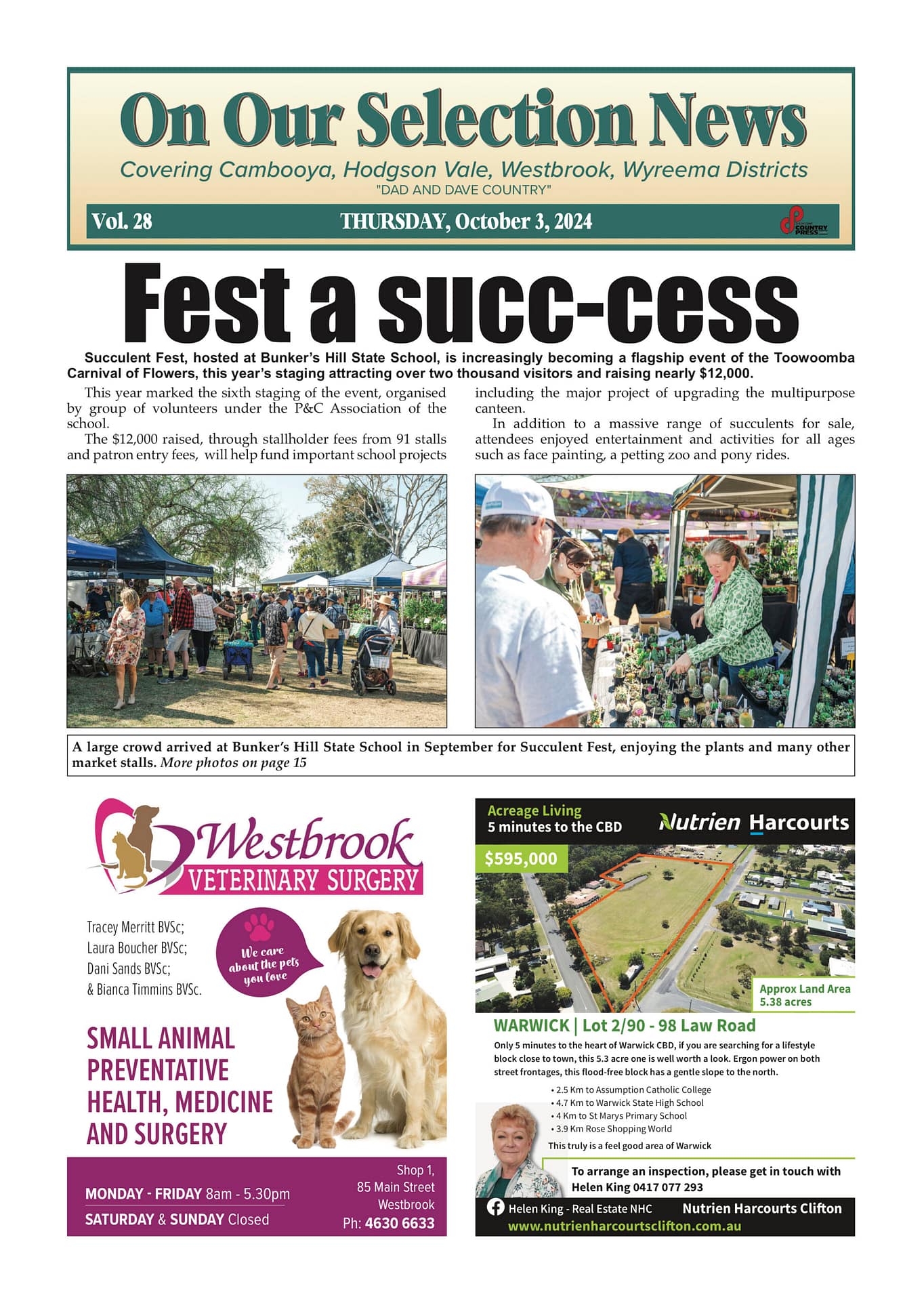
This article appeared in On Our Selection News, 3 October 2024.
