

Urbanisation has a negative impact on the Ukrainian family and the renewal of the population of Ukraine.
In the conditions of catastrophic population decline, Ukraine needs to renew the ancient family values ”‹”‹laid down by rural residents hundreds of years ago.
At the end of the 18th century, Ukraine was an agrarian country with a small urban population. The 10.5 million peasants who lived in the country at that time conceived half a million children every year.1 After 200 years, the population of Ukraine had increased 4.5 times and reached 45 million people,2 70 per cent of whom lived in cities.3 But… the number of children born each year remained unchanged and amounted to about half a million.4 Incredible!
Let’s be honest, the reasons for what happened are hidden not only in the change in the share of rural and urban population. However, this factor is of great importance. After all, even in modern Ukraine, rural families are characterised by better statistical characteristics than urban ones.
Comparative characteristics of rural and urban families in Ukraine
In the period from 1979 to 1989, the share of single-parent families increased in Ukraine from 12.8 per cent to 13.5 per cent. From 1989 to 2001, this figure increased to 17.1 per cent.
In cities, the share of single-parent families increased from 13.1 per cent in 1979 to 14.8 per cent in 1989. From 1989 to 2001, the share of such families grew in cities to 19.3 per cent in 2001. The growth rate of single-parent families in cities is almost twice as high as in villages. The reasons for this are the higher prevalence of divorces in cities, the birth of children out of wedlock, the diversification of forms of marital and family relations, etc.
The rural population maintains a more traditional attitude towards marriage. Therefore, the share of single-parent families in rural areas is growing more slowly or even decreasing. The share of single-parent families in villages decreased from 12.3 per cent in 1979 to 10.8 per cent in 1989. From 1989 to 2001, this figure increased in villages to only 12 per cent.
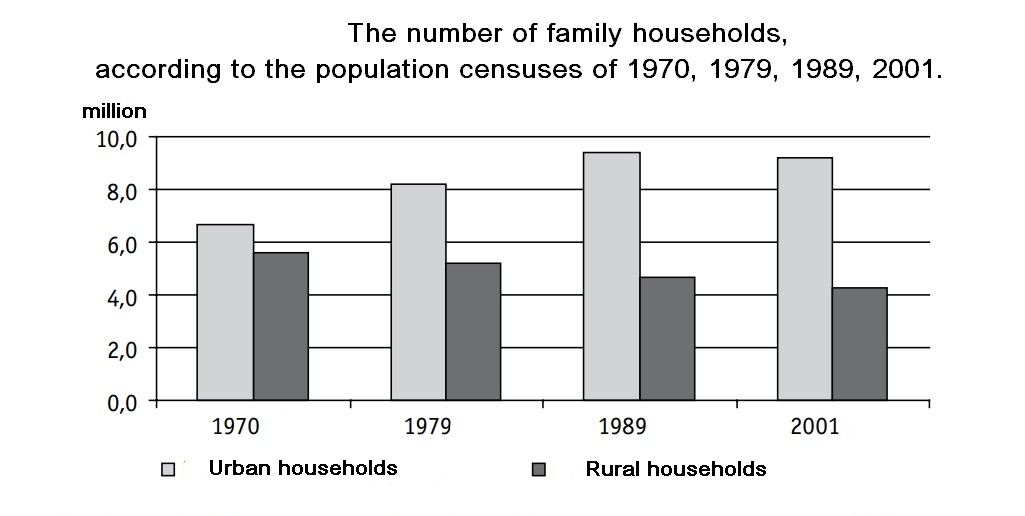
From 1970 to 2001, the average size of a Ukrainian family decreased from 3.4 to 3.2 people. However, the decrease was due to the cities. In villages, this value, on the contrary, began to grow after the decrease. In urban settlements, the average family size for the period 1970-2001 decreased from 3.3 people to 3.1 people. For the period from 1970 to 1989, this figure decreased in villages from 3.6 to 3.3 people. Then, from 1989 to 2001, the average family size in rural areas increased from 3.3 to 3.4 people.
In 2001, the average household size in Ukraine was 2.6 people. However, in rural areas, this figure was 2.8 people. And in cities, the average household size was 2.6 people. Single-person households account for more than a quarter of all individual households (25.9 per cent).
The main reason for the reduction in the average family size is the growing popularity of one- and two-child families. The increase in the share of single-parent families, the aging population, voluntary childlessness and the nuclearisation of families also have an impact. All these trends have been observed for several decades not only in Ukraine but also in Europe.
In 2001, the share of households with minor children in Ukraine was 51.5 per cent. In 1989, this figure was 56.4 per cent. In quantitative terms, the number of families with minor children decreased from 7.9 million in 1989 to 6.9 million in 2001. The reduction in the share and number of such families occurred due to the cities. There, from 1989 to 2001, the share of families with children under 18 decreased by 14 per cent! During the same period, the share of such families in rural areas, on the contrary, increased by 3.9 per cent.
In 2008, the share of households with minor children was the same in the city and in the village. However, in terms of the number of children under 18, rural families differed from urban families.
Women in cities very often refuse to have a second or third child. Three out of four urban families raise only one child! In rural areas, the share of such families is lower. But in rural areas, the share of families with many children is higher. For example, in 2008, 22.1 per cent of families in cities had two children. In rural areas, 32.8 per cent of families had two children.
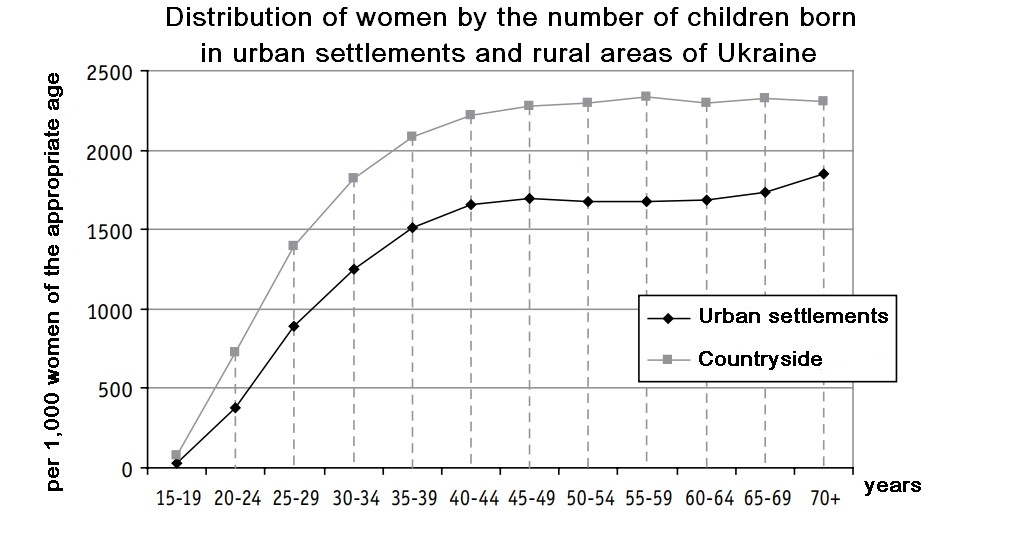
Rural women give birth to children more actively than urban women. In 2001, the average number of children born to one woman in rural areas was 2.3 children. This is 35.3 per cent more than in the city. The average number of children born to an urban woman was only 1.7 children. Rural women give birth more due to several factors. In rural areas, women give birth at an earlier age, they better observe marital values. The birth rate of children in villages is also promoted by the lifestyle, specifics of work, and level of education.5
What is the secret of a rural family?
As we can see, rural families are much more efficient than urban families. The reason for this is the traditional lifestyle of the Ukrainian village. This is very different from the usual urban life of modern Ukrainians. Svetlana Khromova told about how Ukrainian peasants lived, referring to the memories of her grandmother and great-grandmother.
Do you know how your family has developed in recent generations?
Yes. I remember my great-grandmother Marusya and great-grandfather Yakov Korovchenko, as well as grandmother Raisa and grandfather Ivan Prokopenko. My great-grandmother had 10 children. My grandmother had three children. But my parents had only two children. I have not given birth to any yet. My sister gave birth to only one child.
My great-grandmother and grandmother lived in the village of Studenok, Donetsk region. They had a traditional Ukrainian house made of clay bricks. The plot of land was half an acre. My great-grandmother and great-grandfather were engaged in agriculture. They kept a cow, geese, chickens. But my grandparents stopped participating in agriculture. My grandmother worked in a rural hospital, and my grandfather worked at a factory in the city. However, they still retained the skills of their ancestors. My grandfather made good baskets from wicker and sold them at the market. My parents did not live in the village of Studenok and moved to the city of Kramatorsk. While my grandparents were still alive, we went to the village of Studenok to relax in the summer. But when they died, the house remained empty. Only sometimes we went there. During the war with Russia in 2023, our house in the village of Studenok was destroyed. So we lost the family nest where two generations of my ancestors had raised 13 children.
Why is the number of children in your family decreasing?
It’s all about changing lifestyles. People have become more civilized and their attitude towards children has changed. In my great-grandmother’s time, people didn’t know what contraceptives were, didn’t have abortions and didn’t plan families. They had as many children as they could conceive. People worked in the fields, in the fields and gave birth to children. Surprisingly, the peasants didn’t live richly, although their families were large. In those days, there was a popular saying: “God gives a child, which means God will give everything that the child needs.” The whole family worked, even the children. The values ”‹”‹were different. Money was not the main thing. The main thing was to have food and love in the family.
Nowadays people have become more cautious and fearful. People do not want to take risks and overcome difficulties in raising children. A large family has ceased to be a tradition. Many believe that a large family is a sign of ill-being. There is relatively little money in such a family. Why have many children? After all, it is a big expense. It is better to have one child and spend the remaining money on yourself. Many modern Ukrainians think so. People’s health and ecology have also become worse. Many want at least one child, but cannot give birth.
You didn’t start living in the city like your parents, but returned to the village. Why?
Life here is more correct, calmer. You can do gardening, knitting, breed pets. In the village, the race for money is less pronounced than in the city. There are more prerequisites for thinking about the meaning of life and conceiving children.
Modern days
Unbelievable! But despite urbanisation, the natural call of nature makes Ukrainians return to the villages. This gives hope that the Ukrainian people will not die out and will preserve their roots. It is quite possible that after the end of the war, the village will become the driver of population growth in Ukraine.
So far, the situation is deteriorating sharply due to the war, economic downturn, moral decay and dozens of other troubles that have plagued Ukraine for the past 10 years. From 2013 to 2021, the overall birth rate in Ukraine decreased by 40 per cent.6 In 2022, due to the outbreak of war with Russia, this figure decreased by another 25 per cent. In 2023, the birth rate declined by another 9 per cent. As a result, only 187,387 children were born in Ukraine in 2023!7 This is a demographic catastrophe! Now even half a million children seems like a fantastic result!
The Ukrainian authorities are helpless. But the Ukrainian people have a natural protector. This protector is the traditional way of life in the countryside. Those people who follow this way of life will be able to preserve their lineage. After all, a decrease in the birth rate is not only a reduction in the total population of the country. It is also the end of many individual lineages. Trying to continue their lineage with the traditions of their ancestors, Ukrainians will be able to revive their country.
References
1. https://tsn.ua/ru/exclusive/takogo-ne-bylo-230-let-ukraincev-rozhdaetsya-katastroficheski-malo-gde-iskat-vyhod-2559526.html
2. https://daily.rbc.ua/rus/show/naselenie-ukrainy-za-2010-g-umenshilos-do-45-778-mln-chelovek-16022011144500
3. https://uk.wikipedia.org/wiki/Урбанізаційні_процеÑи_в_Україні
4. https://forbes.ua/ru/news/narodzhuvanist-v-ukraini-skorotilasya-na-tretinu-vid-dovoennogo-rivnya-opendatabot-31012024-18877
5. https://ukraine.unfpa.org/sites/default/files/pub-pdf/Family-ukr-WEB_copy.pdf
6. https://opendatabot.ua/ru/analytics/depopulation-2021
7. https://forbes.ua/ru/news/narodzhuvanist-v-ukraini-skorotilasya-na-tretinu-vid-dovoennogo-rivnya-opendatabot-31012024-18877
