


Professor Matthew Harrison, Tasmanian Institute of Agriculture, University of Tasmania, May 2025. Professor Harrison is a co-author of the paper, “Costs of transitioning the livestock sector to net-zero emissions under future climates,” published in Nature Communications, April 2025, DOI: 10.1038/s41467-025-59203-5. Australian Rural & Regional News asked a few further questions of Professor Harrison, answered below.
While practices for reducing or removing greenhouse gas (GHG) emissions abound, little information exists on the combination of practices required to reach net-zero emissions, the cost of transitioning to net-zero, or how carbon removals may change under hotter and more variable conditions expected with climate change.
In a recent paper, “Costs of transitioning the livestock sector to net-zero emissions under future climates”, we assessed pathways for transitioning livestock farms to net-zero GHG emissions.
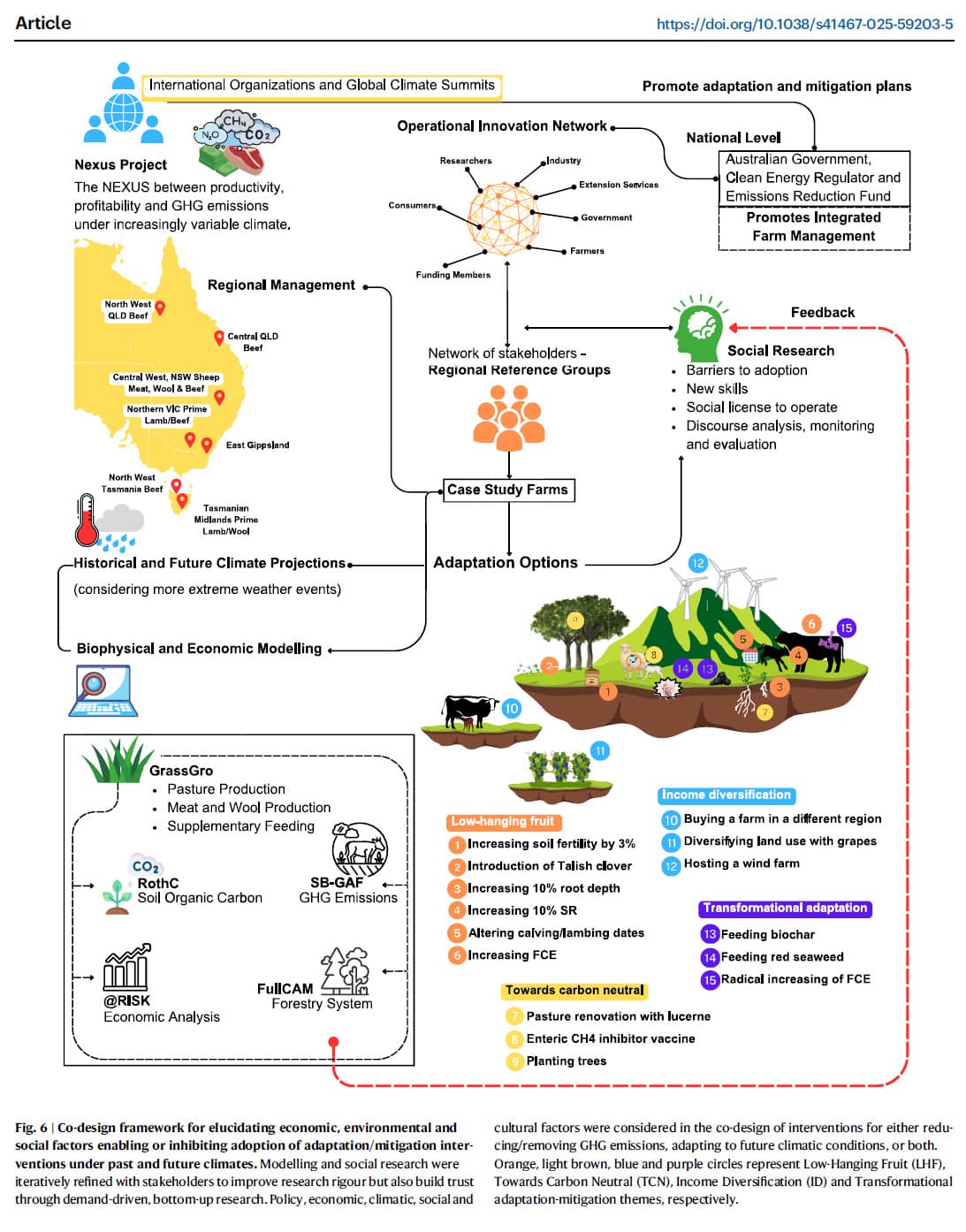
Using a co-design approach with industry stakeholders, we modelled the impacts of several combinations of practices for reducing and removing GHG emissions:
- Improving soil carbon storage by grazing management and pasture renovation;
- Improving carbon storage in vegetation by planting native tree species on farm;
- Improving livestock feed conversion efficiencies (essentially allowing animals to put on more weight with the same amount of feed intake);
- Adopting anti-methanogenic feed additives such as Asparagopsis or biochar to inhibit enteric methane emissions;
- Revenue diversification with renewable energy (wind turbines) or irrigated grapevines to reduce dependence on rainfall for income.
We show that few interventions enhanced productivity and profitability while reducing GHG emissions. Antimethanogenic feed supplements and planting trees afforded the greatest mitigation, while revenue diversification with wind turbines and adoption of livestock genotypes with enhanced feed-conversion efficiency were most conducive to improving profit.
Serendipitously, the intervention with the lowest social license—continuing the status quo and purchasing carbon credits to offset emissions—was also the most costly pathway to transition to net-zero. In contrast, stacking several interventions to mitigate enteric methane, improve FCE and sequester carbon entirely negated enterprise emissions in a profitable way.
We conclude that costs of transitioning to net-zero are lower when interventions are bundled and/or evoke productivity co-benefits.
Australian Rural & Regional News asked a few further questions of Professor Harrison.
ARR.News: This research seems to have targetted large scale farming operations, agribusinesses. Is climate diversification by, as the paper suggests, buying farms in different climate zones and establishing complementary crops (irrigated grapevines, deep-rooted legumes) really feasible for a small to medium sized operation? What, for instance, is the payback time of purchasing another 110ha to establish a tree plantation (as referenced in the paper)?
Professor Harrison: It aimed at small and large producers. We assessed small and large scale investments in the paper, noting that all of these adaptations were suggested in the first place by farmers. It is demand driven. For example, improving soil fertility and renovating pastures with legumes are done on a routine basis by all livestock producers (other than those in the rangelands).
ARR.News: The stacking interventions concept seems to be key to this research. Are there some overarching factors farmers should consider and balance when investigating the potential of their stacking interventions to reduce emissions and increase profit for own farms?
Professor Harrison: Stacking (or combining practice changes) is highly topical with industry at the moment. The key conclusion from this work was that there is a trade-offs between benefits derived and complexity. Doing nothing (the simplest option) and purchasing carbon credits to offset all farm emissions was the most costly option. In contrast, stacking interventions that (1) reduce enteric methane, (2) sequester carbon and (3) improve livestock productivity would not only get the farm to net zero, but would also improve profit. So the cost would be zero. BUT the challenge with stacking is complexity. Reducing enteric methane is difficult to enact for grazing systems (we only looked at the potential outcome, rather than the mechanics of doing so).
ARR.News: Have you considered that the costs used as the basis for your projections could change? For example, the research says that feed additives are the most promising method for reducing livestock enteric methane emissions but also one of the most expensive. Doesn’t this suggest that increasing the supply and reducing the cost of these feed additives could be the most effective and accessible method for farms of all sizes? Have you investigated ways that the supply of feed additives might increase and the cost decrease? Is this possible?
Professor Harrison: We account for variable livestock and carbon prices, as well as costs (the supplementary information contains a sensitivity analysis). The conclusion you refer to relates to current prices. Reducing the cost of feed additives would make this option more attractive but how low do you go? And to what level should livestock and carbon prices increase? Extrapolating the economics too far would create too many uncertainties. At the moment, feed additives result in the greatest reduction in enteric methane (which is a livestock farms biggest GHG) but they also cost the most of available options.
ARR.News: How do seaweed feed supplements compare with biochar feed supplements in terms of enteric emissions reductions? And in terms of cost, currently?
Professor Harrison: Seaweed reduce enteric methane by 80% (depending on how often and how much they eat). Biochar has very little effect (and deserves further research). The biochar we examined in the field increased cattle liveweight gains by 5%, but we had no compelling evidence that seaweed improved productivity. If it did, it would be more cost-effective. We assumed biochar cost $2/kg dry matter and Asparagopsis similar (assuming the Asparagopsis was 0.5% of daily intake).
ARR.News: Your research suggests biochar is less cost effective with sheep than cattle, is that so?
Professor Harrison: Yes, mainly because we found no empirical evidence for biochar increasing the LW gain of sheep (whereas our experiments showed that cattle LW gain increased by 5%). It is worth noting that we assumed biochar would enrich manure organic carbon and thus improve soil carbon. We also assumed farmers would be paid for this improvement in soil carbon relative to the baseline.
ARR.News: Given biochar’s additional benefits, in terms of recycling organic farm waste, isn’t it too a key method that could be effective and accessible for farms less than agribusiness size?
Professor Harrison: Yes, but deserves further research. We don’t know if or how it impacts on enteric CH4, or the contexts under which LW gain is improved (and use of biochar is cost effective).
ARR.News: Given the ongoing disagreement in Australia over the way renewables are being rolled out, such as the siting of wind turbines and transmission lines, the environmental impact of wind turbines, their lifecycle carbon cost, decommissioning (the Codrington wind farm is a recent example) and the social cost of polarised communities, adding in wind turbines as a potential way to reduce overall emissions and increase income makes this a political paper. The paper concludes that “revenue diversification with wind turbines and adoption of livestock genotypes with enhanced feed-conversion efficiency (FCE) were most conducive to improving profit.” However, it references “hosting a wind farm (by leasing land for 12 wind turbines …)” which is a number only certain large holdings could support. The amount paid by the energy company per turbine does not seem to be stated (?). Nor is there discussion of the affect on the sale price of livestock that is grazed under turbines (I understand that farmers selling stock now need to state whether it has grazed under turbines (?), due to the PFAS shedded (?))
Are you concerned that this paper will be misused to support a bald political argument that the only way farms can be viable and reduce emissions is to host wind turbines? How would you counter this?
Professor Harrison: Many of those details are in the supplementary information (see below). These statistics were given to us by the farmer. He operated an average sized beef cattle farm on the NW coast of Tasmania. He had been approached by a wind turbine company and will go ahead with the wind turbines, so we know that these stats are robust.
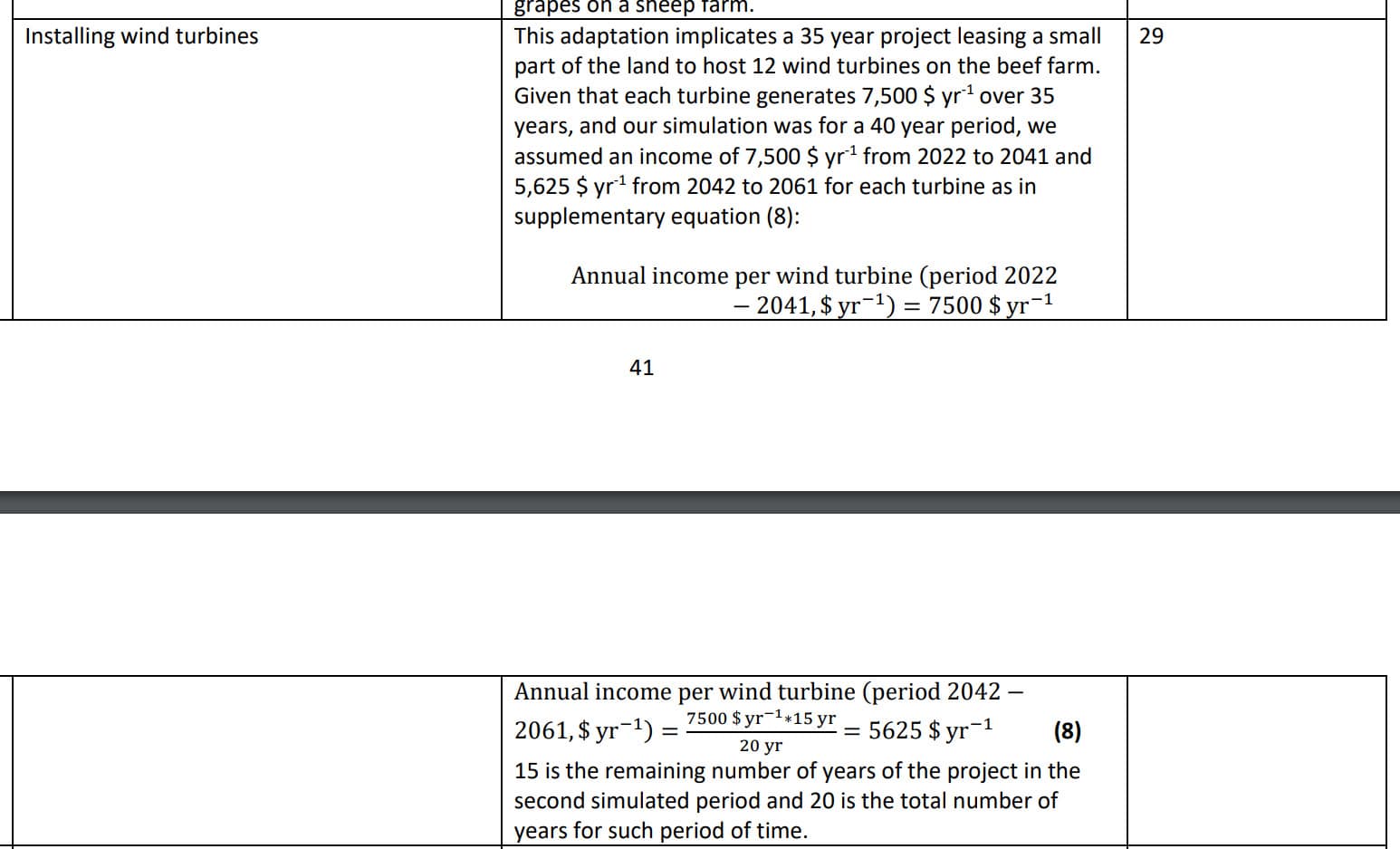
We need to be cognisant that this is a modelling study. We modelled those adaptations that the regional reference group were most interested in. But a model is a simplification of reality. No model can account for everything (e.g. PFAS). If it did, it would not be a model but would be reality. This is why models are created: so they can address the central question and simplify other aspects of reality.
It is worth noting that only a select few regions could be used for renewable energy (either wind or solar). This is because they need to be close to three-phase powerlines and have ideal conditions (e.g. high winds near the coast or north facing aspect for solar). I don’t see this conclusion as being misconstrued by politicians, as the practical realities of site requirements associated with renewable energy will prohibit renewables ever becoming something adopted en masse.

