

Encouraged by the interest and support shown over previous years, the Upper Murray Historical Society recently held a walk through the old Corryong Pioneer Cemetery.
As it turned out the weather could not have been more perfect and an estimated 35 people attended.
This year the guest speakers were Vicki Kane, Choc Thompson, Bob Herbert, Tom Lebner and his sister Fairlie Joyce and John Murphy.
Vicki was the first speaker at Jack Riley’s grave, which had been covered on a cemetery walk some years back but history sleuth Vicki recently uncovered some previously unknown information largely pertaining to Jack’s childhood and early life in Australia that certainly helps to further fill in the picture of the man.
Choc Thompson spoke of his own family’s interesting history and the events that brought them to settle in Corryong. The Thompsons, headed by Lewis Thompson, were noted saddlers, harness-makers and leather workers and first commenced their business in this town near the Corryong Hotel (‘Bottom Pub’). Later they moved their premises closer to a new section of the town that was fast developing around the intersection of Towong Road and Donaldson Street. Their saddlery and family home stood for many years on Towong Road opposite the Corryong State School.
Choc said that the actual saddlery (located where the CWA building was later erected) burnt down in the early 1900s and from then on the business was conducted from the home which is still standing.
The Thompson family was very much involved in the early development of Corryong and supported many clubs and causes.
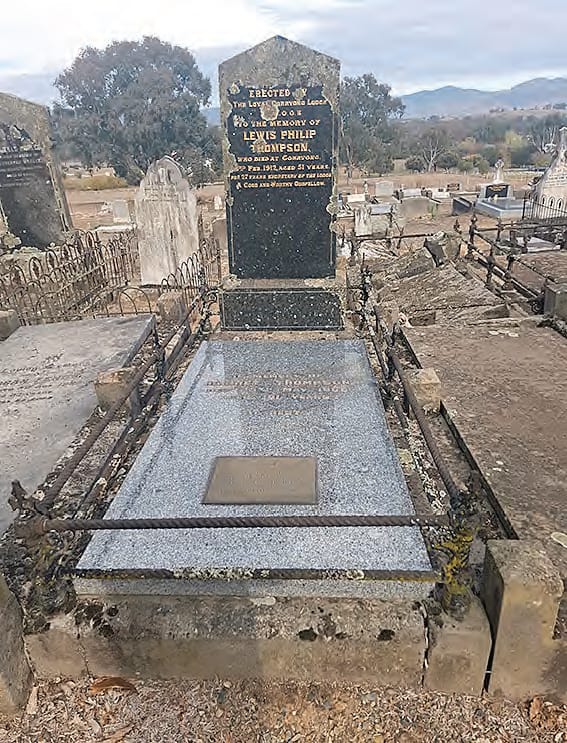
When Lewis died the MUIOOF Lodge paid to erect an impressive headstone over his grave in recognition of his, and his family’s work (pictured). Choc added that, as time went on, other family members were interred in the grave and it now contains five bodies.
This grave is surely unique for the Corryong Pioneer Cemetery.
Bob Herbert spoke of one of his ancestors in William Edward Phillips who was born about 1861 and died in 1928, aged 67 years.
William (or Eddy) was a bullocky, one of the heavy haulers of the day and with his team of bullocks he plied the road between Albury-Wodonga and Corryong and later between Old Tallangatta and Corryong.
This was a tough route as Corryong lay east of the Koetong Range and on the Tallangatta side there was the steep pinch known as ‘Darbyshire Hill’ and on the Corryong side there was the rise known as ‘Keelangie’ to be scaled. No doubt William did many other cartage jobs as required.
He was also interested in local racing and owned a number of racehorses which he trained and rode himself at both the Towong and Corryong racecourses. The Corryong course was located in the Corryong Recreation Reserve and they raced around the perimeter of the existing oval.
It is from these hardy and interesting personalities that the character of our district is built.
Tom Lebner and his sister Fairlie, with occasional input from older sister Prue, recounted memories of their grandparents George and Hersey Moore who arrived in Corryong in 1919. Before coming to Corryong, George lead a colourful life in and around Melbourne but he was lured away from the city by local mechanic and businessman Mr J.C. Brown with the promise of higher wages. This was after he met and married the love of his life.
In his old job at Munro Motors in Melbourne he was earning took on a job with £3/-/- a week but in Corryong Mr Brown paid him an impressive £5/12/6. George eventually began his own motor agency, mechanical repairs and engineering business where the Corryong Neighbourhood Centre now stands. He was also agent for the Shell Motor Spirits Co. Many older residents of Corryong would well remember his service station with the red and yellow bowsers out front.
In 1921 George went into partnership with Alf Venner showing silent movies at the Athenaeum Hall and George’s wife Hersey accompanied the showing of these movies with background music on her piano to create the mood. The piano could also be loaded with perforated rolls to give Hersey a rest. In 1930 the ‘talkies’ made their appearance but it took some years for the silent movies to fade away and put Hersey out of a job.
For a time she ran a confectionery business and ‘fast food’ business across the road at the Oriental Café which later became the Crystal Café across the road but younger residents would know it as the recent site of the Craft Shop.
The ‘fast food’ referred to above was Hersey’s homemade pies. People would travel many miles to purchase them and they disappeared very quickly.
Like the Thompson family, the Moores were heavily involved with the community and Tom and Fairlie gave an often humorous account of their life.
John Murphy spoke of the Evans sisters from Thowgla, the daughters of Joe and Grace Evans – Margaret (1876) and Millicent (1883). Both died in 1942. The focus of this talk was to highlight the load that fell upon mostly women when a member of a family in those days required full time care. Millicent (or Milly as she was better known) was not capable of looking after herself and as her family aged, her care fell on her older sister Margaret. It was a full time job but done with love and care. When Milly died in 1942 her sister Margaret survived her by only 26 days.
The above is only a snapshot of the talks given. Copies of the full talks are being preserved by Margaret Jarvis in the hope that they will be useful for future generations to learn something of their ancestors.
This article appeared in Corryong Courier, 15 May 2025.

