


The government to the Duch East Indies was largely concerned with trade, from the time it took over from the VOC (East India Company) in 1800. Cultural concerns were at first of little interest, but over the 19th century it became obvious that the islands had a wealth of fine crafts and buildings. In eastern Java two outstanding monuments demanded attention: the step-pyramid Buddhist temple of Borobudur (9th century), and the multi-tower Hindu temple of Prambanan (mid-10th century). In addition, East Indies officials started to record and collect objects such as fine textiles and sculptures. Many of these artefacts made their way to Dutch museums, e.g. the Volkerkunde in Leiden, or the Tropenmuseum in Amsterdam (both now rebranded as World museums). However, Balinese crafts were little known as the island was of relatively minor importance to trade, though there was a large port at Singaraja on the northern coast.
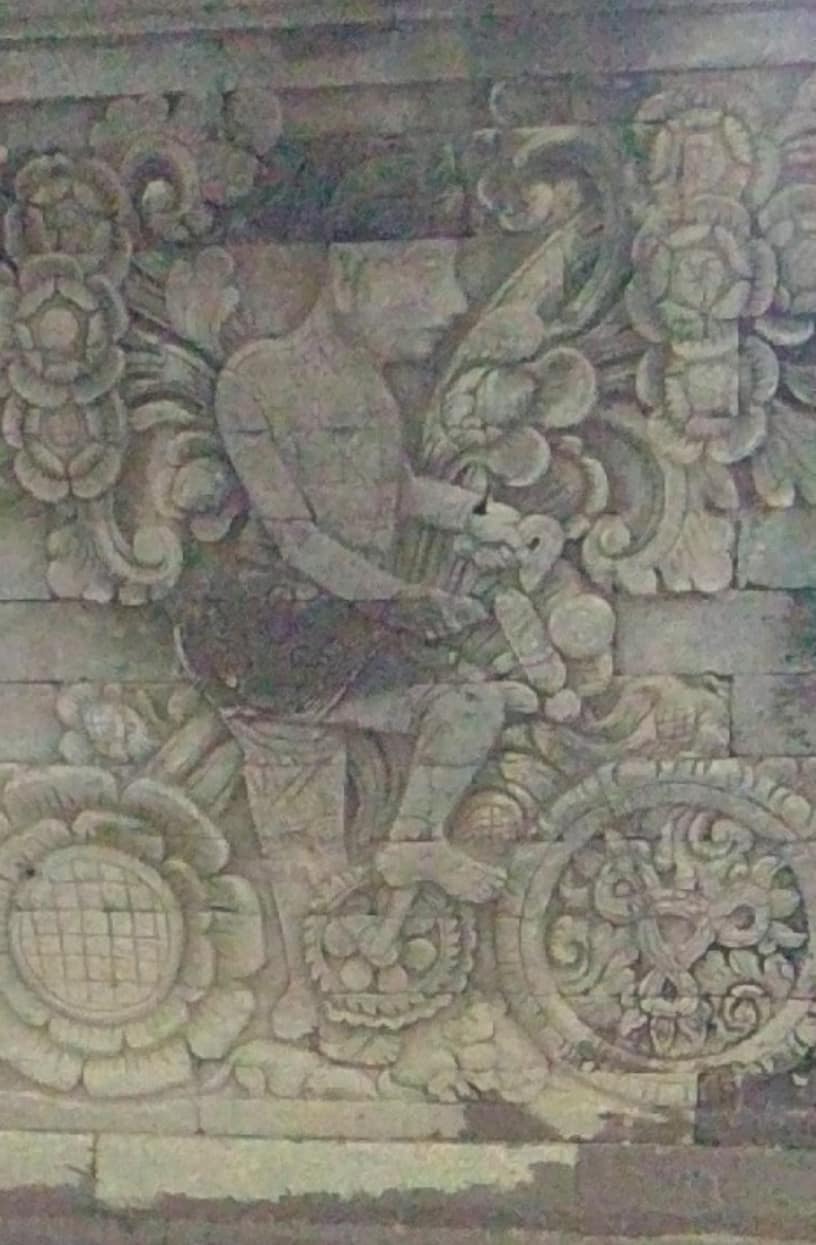
All this changed in 1903, when the island was visited by W.O.J. Nieuwekamp (WOJ, 1874-1950), a self-taught artist and journalist, who recognised the astonishing virtuosity of local artists, be they weaver, carvers, painters or builders. His travelling companion was the archaeologist/ethnographer Franz Heger (1853-1931), who was later to found the Museum of Ethnology in Vienna. The story goes that when they were forbidden entry to a temple on the slopes of Mount Barut, WOJ left Heger to argue, scaled a back wall and quickly started to sketch the temple. When the locals saw his work, they fell silent with admiration.1 From then on, he was not just tolerated but greeted with affection. He is said to be the man on a bicycle carved on one of the walls at the Maduwe Karang temple, near Sinagaraja. This is quite likely, given that he was the first person to bring a bicycle into Bali.2
W.O.J. Nieuwekamp’s specific contribution to archaeology, still cited today, was his measured drawing of a revered bronze drum, the ‘Moon of Pejeng’. Said to be the world’s largest ‘kettle-drum’ (ht 186 cm, max diam. 160cm), it is housed in the Penataran Sasih temple, near Ubud, Gianyar. The Moon of Pejeng was first made known to the Western world by the German-born naturalist Georgius Everhardus Rumphius/Rumpf (1628-1702) in his D’Amboinsche rarietkamer, published in Amsterdam in 1705.3 Rumpf had never seen it and thought it was a wheel, with part of its shaft attached.
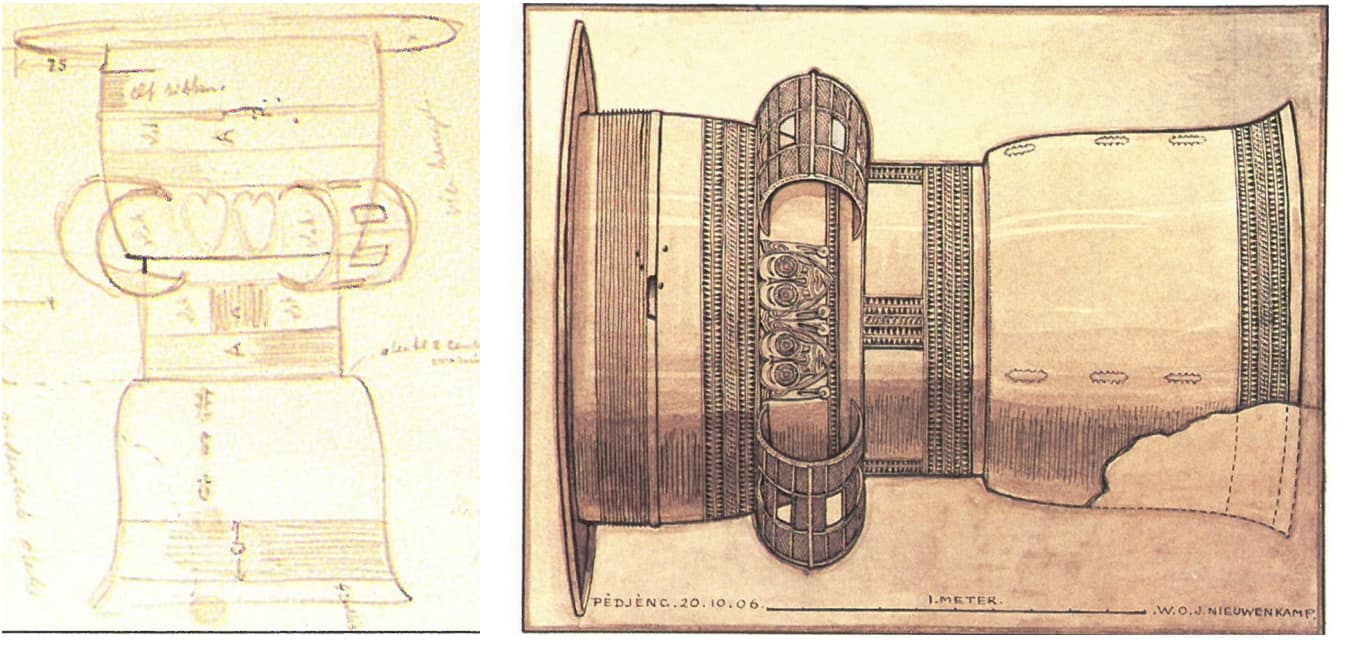
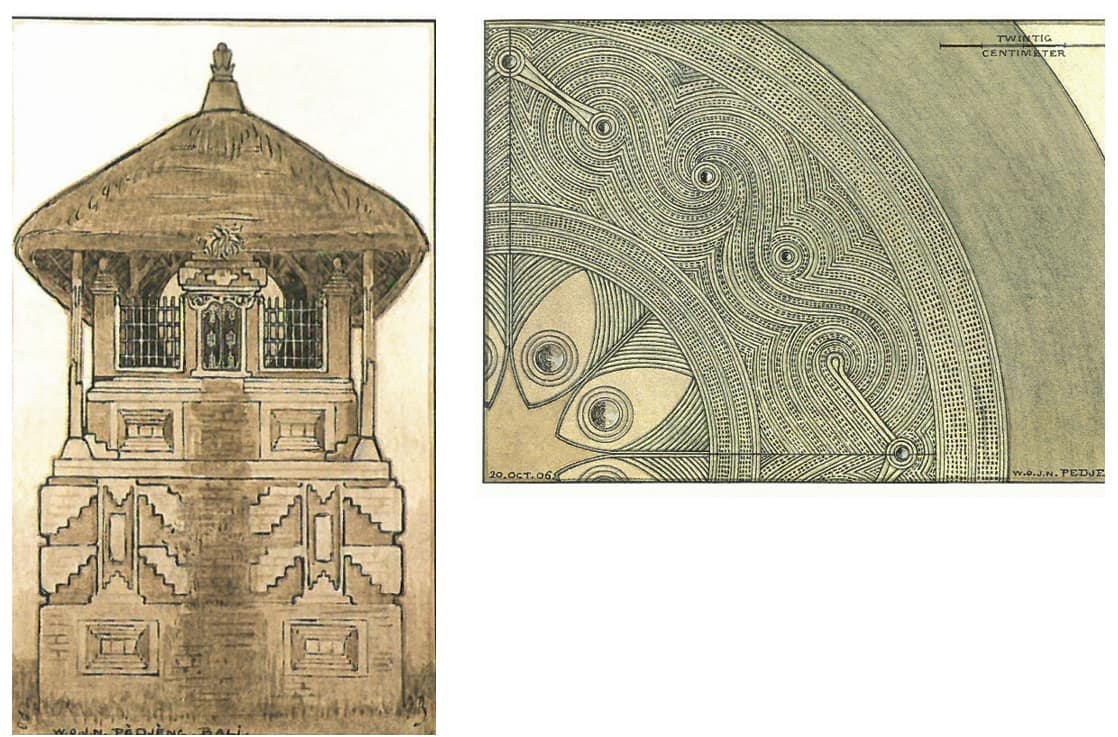
WOJ’s friend Franz Heger had in 1902 devised a typology for bronze drums, which was in use for well over a century. The Pejeng object falls roughly into Heger’s Type I, based on the drums from Dong Son, on the Red River delta in northern Vietnam. But those are cast in one piece, whereas the Pejeng type is in two parts: a waisted cylinder with a separate upper section, or tympanum, the ‘moon’, which is slotted vertically onto the cylinder though a ‘cuff’.
The drum is made of a copper alloy and cast in lost-wax technique. In that method, the object is first created in wax, over a clay core; the outer layer of wax is impressed with decorative motifs carved onto a stone mould?one was found at nearby Manuaba in 19324?then encased in more clay. The whole thing is heated, the wax melts away and is replaced by the molten metal, which fills all cavities, thus replicating the moulded ornament.5 This sophisticated method is widely accepted as derived from the Dong Son tradition and it seems that the makers in Bali may have melted down imported drums to produce the metal for the local type.6 In any case, the craftsmanship is truly remarkable in a place which had little experience of metalworking.
After his time in northern Bali WOJ moved on to Lombok and by 1905 had gone back to the Netherlands where he started work on a very large book on Bali and Lombok. His proposed layout was so ambitious that he had to publish it in separate volumes, the first coming out in 1906. Fortunately, his wife was wealthy and happy to subsidise him?his own family, prosperous shipowners, having more or less given up on him. But WOJ was also able to get money by writing articles for the Dutch press and selling some of his sketches. He soon became quite well known and was able to secure academic funding for his next trip, in mid-1906, to southern Bali.
That voyage was emotionally disastrous, as WOJ became an unwilling witness to the mass suicide?puputan ‘fight to the death’?of the court of Badung at its Denpasar and Pamecutan palaces, caused by Dutch over-reaction to a relatively trivial matter, the looting of a wrecked Chinese trading vessel. Official sources claimed that 450 people died, WOJ thought it was over 1800. He was horrified to see Dutch soldiers vandalising the palaces, but was able to salvage some artefacts, which ended up in the Leiden Museum. WOJ never returned to Bali, but his account of the atrocity filtered through to his friend the Dutch painter Rudolf Bonnet in the 1920s, and through him to the then-celebrated Austrian-American writer Vicki Baum in the 1930s. She wrote a moving, low-key, book about the events, seen from a villager’s point of view. The original was entitled Life and death in Bali (1937), later reprinted as A Tale of Bali (1973).
By 1913 the Dutch government had created a formal archaeological service, Oudheidkundige Dienst, based in Jakarta. Its first two directors were N.J Kromm, 1913 to 1915, and F.D.K. Bosch, 1916 to 1936. Neither one had any interest in Bali though they did take steps toward the establishment of a Bali Museum, which had been promulgated as early as 1910 and was to be located, rather oddly, on the site of the Denpasar palace destroyed in 1906. Construction was slow and the building was not fully completed until 1937.7
In 1926 Willem F. Stutterheim was appointed as an assistant to Bosch. He took more interest in Bali’s archaeology and moved to nominate as curator of this museum, not a formally trained archaeologist or ethnographer, but a locally-based German artist, Walter Spies (1895-1942) who had lived in Bali since 1927 and was widely acknowledged as an authority on the island’s architecture and religious practice. The rationale for appointing Spies was that he was committed to living permanently in Bali, as described by Spies’ friend (and former music student), the Javanese-born art collector, Thomas-Anne Resink (1902-70): ‘The Bali Museum was placed in the extremely favourable situation of securing the services of a person intending to spend the remainder of his life in Bali and whose knowledge of Bali and the arts is difficult to match’. And indeed, the museum’s first holdings came from Spies’ own collection, made over five years of exploring the island and attending its festivals.8
Walter Spies was a polymath, and one of great charm. He was born in Moscow where his German family had been successfully involved in the import-export trade since the 1850s, but was educated in Dresden, Germany. During the First World war he was interned in Bashkirdistan [Bashkortostan] in the Urals, where he claimed to have learn Tatar, the local language. In 1918 he had moved back to Dresden, studying with the painters Oskar Kokoschka and Otto Dix, then on to Berlin where he worked with his lover, the filmmaker Friedrich W. Murnau, on the famous Nosferatu (1922). As the political situation in Germany was becoming oppressive, Walter decided to go overseas, working his way as a sailor. On reaching Java he chose to stay there, earning his living by playing the piano in cinemas, teaching and putting on concerts of contemporary European music, until he was hired as court-musician by the Sultan of Yogyakarta in 1924.9
In 1925 Spies visited Bali at the invitation of Cokorda Gde Raka Sukawati (1899-1967) son of the ruler of Ubud. Raka has been educated in a Dutch school in Java and went on to have a brilliant political career, but his younger brother Cokorda Gde Agung Sukawati (1910-78) had had a traditional upbringing in Denpasar.10 Agung and Spies soon became friends and Walter decided to settle permanently in Ubud in 1927. The European population of Bali at the time was just over 200 people, mostly Dutch officials, 132 in Singaraja and 73 in Denpasar.11 Walter was fortunate in that Cokorda Gde Agung could introduce him to traditional artists and explain dance forms.
In 1930 Walter contributed over 80 photographs (making up over half the volume) to a book on The Island of Bali: its region and ceremonies by the Dutch ethnographer, Roelof Goris.12 By 1932 he was actively collecting for the Bali Museum. He had now been joined by the friend of W.O.J. Nieuwekamp, the Dutch painter Rudolf Bonnet (1895-1978), whose brother and sister were already living in the Dutch East Indies.13 Bonnet helped Spies at the Museum, as Sales Director, but more importantly helped to publicise traditional painting and sculpture through the Pita Maha ‘Great Ancestors’ Association’ (1936-42) which organised and exported exhibitions from Nagoya to New York.14
Walter became an indefatigable guide for well-known anthropologists such as Jane Belo, Margaret Mead and her then-husband Gregory Bateson. Bali was by now fashionable and Spies was visited by celebrities such as Vicki Baum, Charlie Chaplin, Barbara Hutton, Cole Porter, etc. many of whom bought his paintings. But all this took so much energy that Walter left Ubud to live in a more rural area. Already Noel Coward had pleaded with him to concentrate on his work:
Oh Walter dear, Oh Walter dear
Please don’t neglect your painting …
Crush down dear Walter if you can,
Your passion for the Gamelan
Neglect your love of birds and beasts,
Go to far fewer Temple Feasts …
Despite all this Walter did find time to work on archaeological sites and made several measured surveys of historic places, such as the abandoned 10th century hermitage of Telaga Wajah, Karangasem, in March 1931. He did not carry out any formal excavations but did expose part of an old rock-cut altar near the Elephant Cave at Goa Gajah, Ubud, in April 1931, and recorded ‘ancient stepped pyramids’ from the mountain village of Selulung, near Kintamani in 1935. He also worked with the Dutch archaeologist Karel C. Crucq (1900-44).
Stutterheim had already in 1930 commissioned him to create historical school posters and in 1936 decided to publish a special issue of Djawa, journal of the scholarly Java Institute. That same year Stutterheim became Director of the Archaeological Service and continue to promote the antiquities of Bali (even though he rarely visited the island), encouraging the Java Institute to hold a Congress there in 1937. Spies rather reluctantly agreed to organise dance performances and to show Congress participants around the Bali Museums. He contributed an article on dance for one of the 1937 issues of the Djawa journal15 and later worked with the dancer Beryl de Zoete on Dance and Drama in Bali (1937).
All of this unravelled in 1938 when the Dutch authorities suddenly had a fit of morality and tried to stamp out homosexuality. Spies was interned for 9 months on (unproven) charges of pedophilia. Released in October 1939 he was almost immediately re-arrested as an enemy alien and was killed when the ship on which he was being transported to British India was torpedoed by the Japanese.
After World War II Dutch archaeologists continued to work within the Republic of Indonesia (proclaimed in1949) and gradually handed over to Indonesian graduates. The last Dutch official was August J. Bernet Kempers (1906-92) who was succeeded in 1953 by R. Soekmono (1922-97). One of the more significant Indonesian scholars was R.P. Soejono, who was at one point ‘the only official of the Archaeological Service’16 working tirelessly around the archipelago and collaborating with foreign researchers when the occasion arose. His most famous Australian collaboration was with Mike Morwood at the Liang Bua cave, home of the ‘hobbit’ on Flores Island, from 2001.17
One of Soejono’s major investigations was the excavation of an Early Bronze Age village and cemetery at Gilimanuk, Jembrana, in the extreme west of Bali, in 1963. The site and its artefacts are beautifully presented in the Museum Manusia Purba/Museum of Early Man, opened in 1990. All of the archaeological material is of interest, but for a foreign visitor the most striking objects are the two stone ‘sarcophagi’, or burial vessels. The type, which seems peculiar to Bali, is a large container, carved in two symmetrical halves out of tufa, a relatively soft volcanic rock, which is abundant throughout most of the island.18 The body is placed in the lower half, often in a flexed position, and the second half placed over it as a lid. Most of these are roughly ovoid, but there are also sub-rectangular or pyramidal shapes. Some are quite elaborately carved.19 At Gilimanuk one is plain, the other has deeply chiselled curvilinear ornament.
Over 200 sarcophagi are said to have been found in the island, and 70 are currently on display at the Gedong Arca Museum, at Bedulu, near Ubud. But at Gilimanuk they have inspired two monumental works of art: one, by ??? is a giant female figure in the ‘flexed’ position of many of the burials. The other, by Ulin Yusron, is a set of six blocks of black andesite from the sacred volcano of mount Agung, in eastern Bali. The blocks are placed in vertical pairs, like the two halves of the stone sarcophagi, but their surface is rough and they are carved with scenes of village life, in a style somewhat reminiscent of the much later carvings at Borobudur.
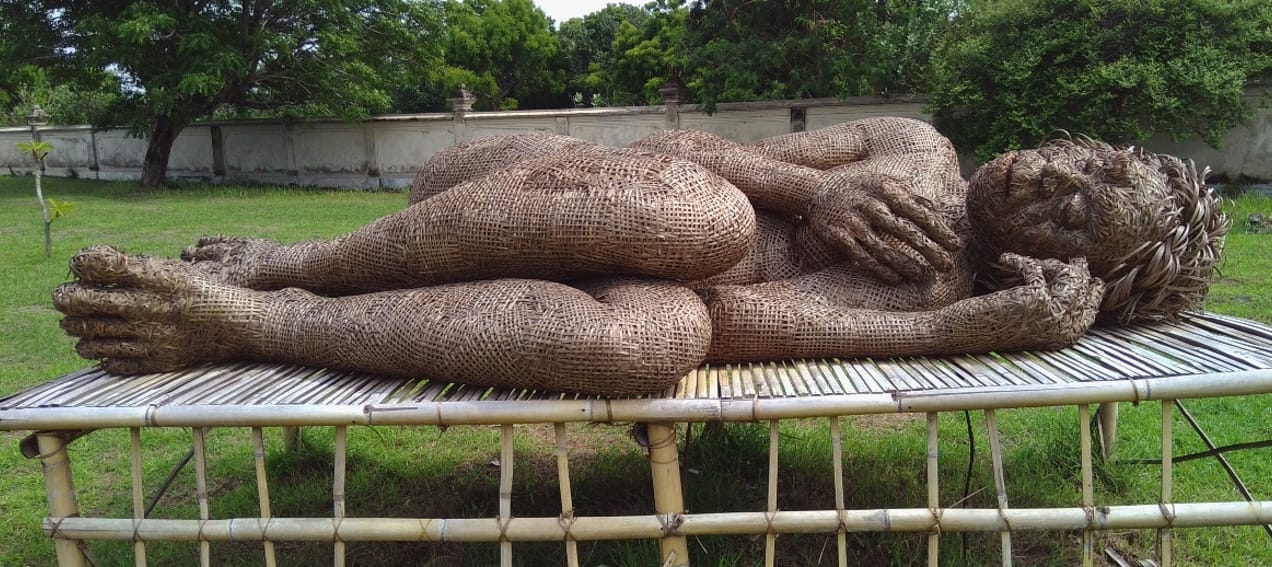
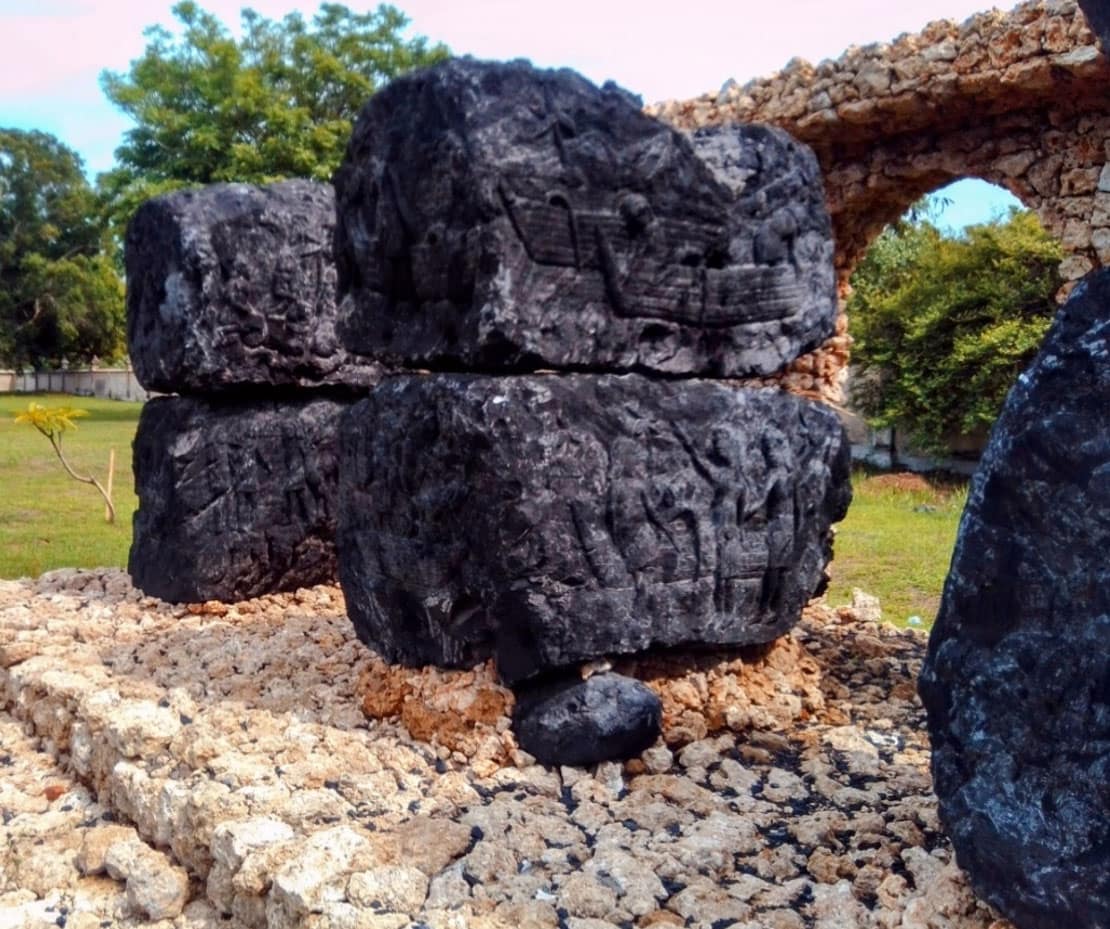
Photos: A Cremin, December 2024.
Gilimanuk is the terminus for ferries coming from eastern Java and, for many travellers, just a rest-stop. But the museum is well worth visiting. It gives an unequalled insight into the life of farmers and fishermen who lived in wooden houses, making their own stone implements and earthenware cooking pots and containers. But they looked out to wider worlds, a material one which furnished metal for tools and weapons, and a now-lost spiritual world represented by the stone sarcophagi.
Acknowledgements
Thanks are due to my fellow-archaeologists Dr Wayne Johnson, who introduced me to Bali, and Dr Lim Tse Siang. At Gilimanuk we were made welcome by Resa Anggarini and Made Wijaya, both of whom I thank very warmly.
References
1. Bruce W. Carpenter, W.O.J. Nieuwenkamp, first European artist in Bali, Singapore: Editions Didier Millet 1997, p.49.
2. Carpenter 1997, p.44.
3. Translated as The Ambonese Curiosity Cabinet, by E.M. Beekman, 1999. New Haven, CT: Yale UP.
4. Van der Hoop 1932, quoted in H.R. van Heekeren, The Bronze-Iron Age of Indonesia, ‘S-Gravenhage, NL: Martinus Nijhoff 1958, pp. 22-24. See also A. J. Bernet Kempers, Monumental Bali: Guide to Balinese archaeology & Guide to the monuments, Berkeley, CA: Periplus, pp. 25-27, and Ambra Calò, ‘Pejeng bronze drums in Bali and Java: the rise of a local tradition at a crossroads between trade routes’. In Jan van Alphen ed. A Passage to Asia: 25 centuries of exchange between Asia and Europe, 2010. Brussels: Bozar, pp. 42-49.
5. A.J. Bernet Kempers, ‘The kettledrums of Southeast Asia. A Bronze Age world and its aftermath’, Modern Quaternary research in Southeast Asia, vol. 10 1986/1987. Rotterdam: A.A. Balkema 1988.
6. T.O. Pryce et al. ‘Copper-base metallurgy in metal-age Bali’, Archaeometry 60.6, 2018, 1271-89, at p. 1286.
7. I.K.D. Noorwatha, et al. ‘East meets West: The Balinese undagi-Dutch architect cross-cultural design collaborations in Bali early colonial era (1910-1918)’, Cogent Arts & Humanities 11.1. 2024, 1-21, at p. 7. https://doi.org./10.1080/23311983.2024.2390792. See also Th. A. Resink, ‘Het Bali Museum’ Djawa 18.1 1938: 73-82.
8. John Stowell, Walter Spies: A life in art, Jakarta: Afterhours Books 2011, pp. 158-60. Resink’s interests are described by Siobhan Campbell, ‘Kamasan art in museum collections’, Bijdragen tot de Taal-, Land- en Volkenkunde 170, 2014, 250-280, at pp. 267-268.
9. Autobiographical letter, reproduced in Stowell 2011, pp. 5-7.
10. Jean Couteau, in Bembi & Soemantri eds. Ubud: A short history of an art and cultural center in Bali, Ubud: Museum Puri Lukisan 2011, pp 27-33 and Museum Puri Lukisan, Ubud: Rama Wartha Foundation 1999, pp. 17-18.
11. Stowell, p. 11, fn 18.
12. Published by KPM (the Royal Packet Company) the principal tourist-ship company, Batavia 1931.
13. Couteau 1999, p. 21.
14. Couteau 1999, pp.30-31.
15. Stowell 2011, pp. 296-7 and 181, 199.
16. R.P. Soejono, ‘The study of prehistory in Indonesia: Retrospect and prospect’, Asian Perspectives 13, 1970, pp. 11-15.
17. M. J. Morwood, R. P. Soejono, ‘Archaeology and age of a new hominin from Flores in eastern Indonesia’ Letter to Nature, Nature 431, 28 October 2004, 1087-91.
18. H.R. van Heekeren, Proto-historic sarcophagi on Bali (1955), reprinted in Berita Dinas Purkanatan no.2, 1992.
19. R.P. Soejono, Sarkofagus Bali dan nekropolis Gilimanuk, Jakarta: Proyek Pelita Pengembangan Media Kebudayaan, 1977. M.M Sukarto K. Atmodjo 1979 ‘Notes on a protohistoric sarcophagus at Selasih in Bali’, Majalah arkeologi 2.4, 1979, pp. 61-74.

